

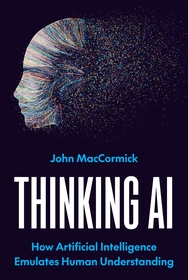
Thinking AI
How Artificial Intelligence Emulates Human Understanding
- Publisher's listprice GBP 25.00
-
11 943 Ft (11 375 Ft + 5% VAT)
The price is estimated because at the time of ordering we do not know what conversion rates will apply to HUF / product currency when the book arrives. In case HUF is weaker, the price increases slightly, in case HUF is stronger, the price goes lower slightly.
- Discount 10% (cc. 1 194 Ft off)
- Discounted price 10 749 Ft (10 238 Ft + 5% VAT)
Subcribe now and take benefit of a favourable price.
Subscribe
11 943 Ft

Availability
Not yet published.
Why don't you give exact delivery time?
Delivery time is estimated on our previous experiences. We give estimations only, because we order from outside Hungary, and the delivery time mainly depends on how quickly the publisher supplies the book. Faster or slower deliveries both happen, but we do our best to supply as quickly as possible.
Product details:
- Publisher Princeton University Press
- Date of Publication 21 April 2026
- Number of Volumes Print PDF
- ISBN 9780691191737
- Binding Hardback
- No. of pages296 pages
- Size 234x155 mm
- Language English
- Illustrations 82 b/w illus. 11 tables. 700
Categories
Long description:
Can a computer program think like a human?
“Can machines think?” Ever since Alan Turing posed this question in an influential 1950 paper, it has been central to research in artificial intelligence. More than seventy-five years after Turing’s paper, we grapple with it every time we wonder if Watson was actually smarter than Jeopardy! champions, or if ChatGPT really knows what it’s talking about. In Thinking AI, computer scientist John MacCormick explores Turing’s question from a perspective informed by a detailed understanding of the way modern AI systems work. MacCormick explains, in accessible fashion, the ideas behind the two main pillars of the twenty-first century AI revolution: deep neural networks and reinforcement learning.
MacCormick offers a tour of the most famous AI systems, including AlexNet and VGG16, deep neural networks for object recognition that led to a Nobel prize; DeepMind’s AlphaGo, which shocked AI researchers with its superhuman performance in the game of Go; and OpenAI’s ChatGPT, which stunned the world with its natural language capabilities. He describes how each system works, and points to parallels with human brain processes. Both human minds and computer programs, MacCormick explains, can induce intelligence through emergence: the capability for new phenomena to emerge from the interactions of many small, simple components. Does this mean that a computer program can think like a human? In many ways, MacCormick argues, the answer is yes. In Thinking AI, he reveals a new landscape of emergent intelligence—a world in which computer programs can emulate many or all aspects of human thinking but humanity retains its meaning and purpose.
"[A] clear-eyed guide to modern artificial intelligence and the philosophical debates surrounding it. Structured like a well-designed undergraduate course, the book moves briskly through core ideas in AI and philosophy of mind, without oversimplifying." More

