

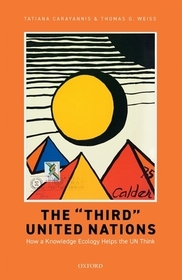
The "Third" United Nations
How a Knowledge Ecology Helps the UN Think
-
10% KEDVEZMÉNY?
- A kedvezmény csak az 'Értesítés a kedvenc témákról' hírlevelünk címzettjeinek rendeléseire érvényes.
- Kiadói listaár GBP 94.00
-
42 441 Ft (40 420 Ft + 5% áfa)
Az ár azért becsült, mert a rendelés pillanatában nem lehet pontosan tudni, hogy a beérkezéskor milyen lesz a forint árfolyama az adott termék eredeti devizájához képest. Ha a forint romlana, kissé többet, ha javulna, kissé kevesebbet kell majd fizetnie.
- Kedvezmény(ek) 10% (kb. 4 244 Ft)
- Kedvezményes ár 38 197 Ft (36 378 Ft + 5% áfa)
Iratkozzon fel most és részesüljön kedvezőbb árainkból!
Feliratkozom
42 441 Ft

Beszerezhetőség
Becsült beszerzési idő: A Prosperónál jelenleg nincsen raktáron, de a kiadónál igen. Beszerzés kb. 3-5 hét..
A Prosperónál jelenleg nincsen raktáron.
Why don't you give exact delivery time?
A beszerzés időigényét az eddigi tapasztalatokra alapozva adjuk meg. Azért becsült, mert a terméket külföldről hozzuk be, így a kiadó kiszolgálásának pillanatnyi gyorsaságától is függ. A megadottnál gyorsabb és lassabb szállítás is elképzelhető, de mindent megteszünk, hogy Ön a lehető leghamarabb jusson hozzá a termékhez.
A termék adatai:
- Kiadó OUP Oxford
- Megjelenés dátuma 2021. február 9.
- ISBN 9780198855859
- Kötéstípus Keménykötés
- Terjedelem222 oldal
- Méret 240x160x18 mm
- Súly 474 g
- Nyelv angol 61
Kategóriák
Rövid leírás:
People often refer to the 'United Nations' but without specifying which specific parts are responsible for success or failure. This book explores supportive the non-state actors that are essential players in developing global policies and norms, alongside the traditional categories of member states (first UN) and staff (second UN).
TöbbHosszú leírás:
The Third UN is the ecology of supportive non-state actors-intellectuals, scholars, consultants, think tanks, NGOs, the for-profit private sector, and the media-that interacts with the intergovernmental machinery of the First UN (member states) and the Second UN (staff members of international secretariats) to formulate and refine ideas and decision-making at key junctures in policy processes. Some advocate for particular ideas, others help analyze or operationalize their testing and implementation; many thus help the UN 'think'. While think tanks, knowledge brokers, and epistemic communities are phenomena that have entered both the academic and policy lexicons, their intellectual role remains marginal to analyses of such intergovernmental organizations as the United Nations.
In this impressive book, the authors Tatiana Carayannis and Thomas G. Weiss remind us that the UN system cannot survive without the input and ideas of an array of independent thinkers and players and actors, including research centers, human rights experts, economists, consultants, digital networks, and specialists of all sorts who daily help the UN carry out its Charter obligations. Indeed, in many ways, the unheralded 'Third UN' serves as one of the great strengths of the world's most indispensable security body.
Tartalomjegyzék:
Introduction
The 'Third' UN: Non-State Actors and the World Body's Thinking
NGOs: Sovereignty-Free Partners for UN Policy Development
Commissions and High-Level Panels: How Eminent Individuals Shape UN Thinking
The UN's Knowledge Economy: Think Tanks, Academics, and Knowledge Brokers
Alternative Voices: Challengers of the Normative Post-War Order
Fitter for Purpose? The UN's Normative Future

