

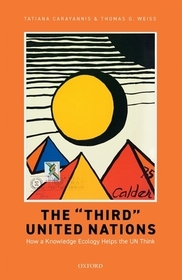
The "Third" United Nations
How a Knowledge Ecology Helps the UN Think
- Publisher's listprice GBP 94.00
-
42 441 Ft (40 420 Ft + 5% VAT)
The price is estimated because at the time of ordering we do not know what conversion rates will apply to HUF / product currency when the book arrives. In case HUF is weaker, the price increases slightly, in case HUF is stronger, the price goes lower slightly.
- Discount 10% (cc. 4 244 Ft off)
- Discounted price 38 197 Ft (36 378 Ft + 5% VAT)
Subcribe now and take benefit of a favourable price.
Subscribe
42 441 Ft

Availability
Estimated delivery time: In stock at the publisher, but not at Prospero's office. Delivery time approx. 3-5 weeks.
Not in stock at Prospero.
Why don't you give exact delivery time?
Delivery time is estimated on our previous experiences. We give estimations only, because we order from outside Hungary, and the delivery time mainly depends on how quickly the publisher supplies the book. Faster or slower deliveries both happen, but we do our best to supply as quickly as possible.
Product details:
- Publisher OUP Oxford
- Date of Publication 9 February 2021
- ISBN 9780198855859
- Binding Hardback
- No. of pages222 pages
- Size 240x160x18 mm
- Weight 474 g
- Language English 61
Categories
Short description:
People often refer to the 'United Nations' but without specifying which specific parts are responsible for success or failure. This book explores supportive the non-state actors that are essential players in developing global policies and norms, alongside the traditional categories of member states (first UN) and staff (second UN).
MoreLong description:
The Third UN is the ecology of supportive non-state actors-intellectuals, scholars, consultants, think tanks, NGOs, the for-profit private sector, and the media-that interacts with the intergovernmental machinery of the First UN (member states) and the Second UN (staff members of international secretariats) to formulate and refine ideas and decision-making at key junctures in policy processes. Some advocate for particular ideas, others help analyze or operationalize their testing and implementation; many thus help the UN 'think'. While think tanks, knowledge brokers, and epistemic communities are phenomena that have entered both the academic and policy lexicons, their intellectual role remains marginal to analyses of such intergovernmental organizations as the United Nations.
In this impressive book, the authors Tatiana Carayannis and Thomas G. Weiss remind us that the UN system cannot survive without the input and ideas of an array of independent thinkers and players and actors, including research centers, human rights experts, economists, consultants, digital networks, and specialists of all sorts who daily help the UN carry out its Charter obligations. Indeed, in many ways, the unheralded 'Third UN' serves as one of the great strengths of the world's most indispensable security body.
Table of Contents:
Introduction
The 'Third' UN: Non-State Actors and the World Body's Thinking
NGOs: Sovereignty-Free Partners for UN Policy Development
Commissions and High-Level Panels: How Eminent Individuals Shape UN Thinking
The UN's Knowledge Economy: Think Tanks, Academics, and Knowledge Brokers
Alternative Voices: Challengers of the Normative Post-War Order
Fitter for Purpose? The UN's Normative Future

