

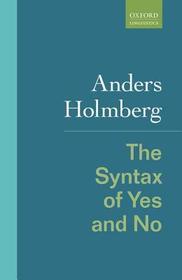
The Syntax of Yes and No
-
10% KEDVEZMÉNY?
- A kedvezmény csak az 'Értesítés a kedvenc témákról' hírlevelünk címzettjeinek rendeléseire érvényes.
- Kiadói listaár GBP 107.50
-
51 358 Ft (48 912 Ft + 5% áfa)
Az ár azért becsült, mert a rendelés pillanatában nem lehet pontosan tudni, hogy a beérkezéskor milyen lesz a forint árfolyama az adott termék eredeti devizájához képest. Ha a forint romlana, kissé többet, ha javulna, kissé kevesebbet kell majd fizetnie.
- Kedvezmény(ek) 10% (cc. 5 136 Ft off)
- Kedvezményes ár 46 222 Ft (44 021 Ft + 5% áfa)
Iratkozzon fel most és részesüljön kedvezőbb árainkból!
Feliratkozom
51 358 Ft

Beszerezhetőség
Megrendelésre a kiadó utánnyomja a könyvet. Rendelhető, de a szokásosnál kicsit lassabban érkezik meg.
Why don't you give exact delivery time?
A beszerzés időigényét az eddigi tapasztalatokra alapozva adjuk meg. Azért becsült, mert a terméket külföldről hozzuk be, így a kiadó kiszolgálásának pillanatnyi gyorsaságától is függ. A megadottnál gyorsabb és lassabb szállítás is elképzelhető, de mindent megteszünk, hogy Ön a lehető leghamarabb jusson hozzá a termékhez.
A termék adatai:
- Kiadó OUP Oxford
- Megjelenés dátuma 2015. december 10.
- ISBN 9780198701859
- Kötéstípus Keménykötés
- Terjedelem264 oldal
- Méret 236x162x20 mm
- Súly 540 g
- Nyelv angol 0
Kategóriák
Rövid leírás:
This book is a cross-linguistic study of the syntax of yes-no questions and their answers, drawing on data from a wide range of languages including English, Finnish, Swedish, Thai, Welsh, and Chinese. It illustrates how this seemingly trivial phenomenon can have the most wide-ranging consequences for theories of language.
TöbbHosszú leírás:
This book is a cross-linguistic study of the syntax of yes-no questions and their answers, drawing on data from a wide range of languages with particular focus on English, Finnish, Swedish, Thai, and Chinese. There are broadly two types of answer to yes-no questions: those that employ particles such as 'yes' and 'no' (as found in English) and those that echo a part of the question, usually the finite verb, with or without negation (as found in Finnish). The latter are uncontroversially derived by ellipsis, while the former have been claimed to be clause substitutes. Anders Holmberg argues instead that even answers that employ particles are complete sentences, derived by ellipsis from full sentential expressions, and that the two types share essential syntactic properties. The book also examines the related cross-linguistic and intralinguistic variation observed in answers to negative questions such as 'does he not drink coffee?', whereby 'yes' in one language appears to correspond to 'no' in another.
The book illustrates how a seemingly trivial phenomenon can have the most wide-ranging consequences for theories of language, and will be of interest not only to theoretical linguists but also to students and scholars of typological and descriptive linguistics.
Tartalomjegyzék:
Introduction
The syntax of questions
The syntax of answers
How to answer negative questions
Some further issues
Conclusions
References
Index

