

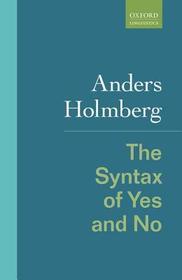
The Syntax of Yes and No
- Publisher's listprice GBP 107.50
-
51 358 Ft (48 912 Ft + 5% VAT)
The price is estimated because at the time of ordering we do not know what conversion rates will apply to HUF / product currency when the book arrives. In case HUF is weaker, the price increases slightly, in case HUF is stronger, the price goes lower slightly.
- Discount 10% (cc. 5 136 Ft off)
- Discounted price 46 222 Ft (44 021 Ft + 5% VAT)
Subcribe now and take benefit of a favourable price.
Subscribe
51 358 Ft

Availability
printed on demand
Why don't you give exact delivery time?
Delivery time is estimated on our previous experiences. We give estimations only, because we order from outside Hungary, and the delivery time mainly depends on how quickly the publisher supplies the book. Faster or slower deliveries both happen, but we do our best to supply as quickly as possible.
Product details:
- Publisher OUP Oxford
- Date of Publication 10 December 2015
- ISBN 9780198701859
- Binding Hardback
- No. of pages264 pages
- Size 236x162x20 mm
- Weight 540 g
- Language English 0
Categories
Short description:
This book is a cross-linguistic study of the syntax of yes-no questions and their answers, drawing on data from a wide range of languages including English, Finnish, Swedish, Thai, Welsh, and Chinese. It illustrates how this seemingly trivial phenomenon can have the most wide-ranging consequences for theories of language.
MoreLong description:
This book is a cross-linguistic study of the syntax of yes-no questions and their answers, drawing on data from a wide range of languages with particular focus on English, Finnish, Swedish, Thai, and Chinese. There are broadly two types of answer to yes-no questions: those that employ particles such as 'yes' and 'no' (as found in English) and those that echo a part of the question, usually the finite verb, with or without negation (as found in Finnish). The latter are uncontroversially derived by ellipsis, while the former have been claimed to be clause substitutes. Anders Holmberg argues instead that even answers that employ particles are complete sentences, derived by ellipsis from full sentential expressions, and that the two types share essential syntactic properties. The book also examines the related cross-linguistic and intralinguistic variation observed in answers to negative questions such as 'does he not drink coffee?', whereby 'yes' in one language appears to correspond to 'no' in another.
The book illustrates how a seemingly trivial phenomenon can have the most wide-ranging consequences for theories of language, and will be of interest not only to theoretical linguists but also to students and scholars of typological and descriptive linguistics.
Table of Contents:
Introduction
The syntax of questions
The syntax of answers
How to answer negative questions
Some further issues
Conclusions
References
Index

