

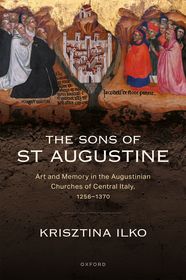
The Sons of St Augustine
Art and Memory in the Augustinian Churches of Central Italy, 1256–1370
-
10% KEDVEZMÉNY?
- A kedvezmény csak az 'Értesítés a kedvenc témákról' hírlevelünk címzettjeinek rendeléseire érvényes.
- Kiadói listaár GBP 99.00
-
44 698 Ft (42 570 Ft + 5% áfa)
Az ár azért becsült, mert a rendelés pillanatában nem lehet pontosan tudni, hogy a beérkezéskor milyen lesz a forint árfolyama az adott termék eredeti devizájához képest. Ha a forint romlana, kissé többet, ha javulna, kissé kevesebbet kell majd fizetnie.
- Kedvezmény(ek) 10% (cc. 4 470 Ft off)
- Kedvezményes ár 40 229 Ft (38 313 Ft + 5% áfa)
Iratkozzon fel most és részesüljön kedvezőbb árainkból!
Feliratkozom
44 698 Ft

Beszerezhetőség
Becsült beszerzési idő: A Prosperónál jelenleg nincsen raktáron, de a kiadónál igen. Beszerzés kb. 3-5 hét..
A Prosperónál jelenleg nincsen raktáron.
Why don't you give exact delivery time?
A beszerzés időigényét az eddigi tapasztalatokra alapozva adjuk meg. Azért becsült, mert a terméket külföldről hozzuk be, így a kiadó kiszolgálásának pillanatnyi gyorsaságától is függ. A megadottnál gyorsabb és lassabb szállítás is elképzelhető, de mindent megteszünk, hogy Ön a lehető leghamarabb jusson hozzá a termékhez.
A termék adatai:
- Kiadó OUP Oxford
- Megjelenés dátuma 2025. december 23.
- ISBN 9780198948827
- Kötéstípus Keménykötés
- Terjedelem464 oldal
- Méret 245x162x30 mm
- Súly 933 g
- Nyelv angol 648
Kategóriák
Rövid leírás:
The Order of the Hermits of St Augustine have long been sidelined as pale imitators of the Franciscans. Seeking to correct this, this book provides a fundamental cross-disciplinary re-evaluation of their lives, ideas, and impacts.
TöbbHosszú leírás:
The Order of the Hermits of St Augustine has long been sidelined as a pale imitator of the Franciscans. This book provides a fundamental cross-disciplinary re-evaluation of the lives, ideas, and impact of the Augustinian friars. By challenging the scholarly focus on the urban sphere in communal Italy, it explores the rapid emergence of Augustinian convents as lively religious and artistic centres on the margins of cities and in the Italian countryside. Moreover, it demonstrates for the first time the existence of common intellectual themes which linked together dispersed Augustinian communities. Fired by contemporary debates about the antiquity of the Order, the Augustinian friars forged a fictive past in which they linked their origins to St Augustine and late antique hermits. The book argues that saints, objects, and the natural environment all played a vital part in brokering the Augustinian ethos. This is underpinned by tracing the 'things' the Hermits commissioned, inherited, and accumulated to become the 'heirs of St Augustine'. Their forged antiquity was promoted not only through human agencies, such as the creation of eremitical saints' cults, but also through the strategic use of the liminal position of their convents, reinventing the Augustinian hermitages as places of power on the margins of the human sphere and the untamed natural environment. At stake here is the extent of religious patronage in the rural landscape and the re-evaluation of the long-standing tension between city and countryside in the medieval imaginary. Ultimately, this book not only challenges the prevailing understanding of the mendicant movement as a quintessentially urban phenomenon, but also sheds new light on broader processes of medieval societies in forging narratives of power, prestige, and antiquity through materiality and the natural environment.
The most original book I read this year was Krisztina Ilko's ^iThe Sons of St Augustine^r: Art and Memory in the Augustinian Churches of Central Italy, 1256-1370Â (Oxford), a brilliant interdisciplinary study of the early history of the Augustinian Order, which should be out in time for Christmas. The Augustinians have been the ugly ducklings of the mendicant orders, but Ilko shows them to be just as important as their more famous Franciscan and Dominican brethren. At a time when an Augustinian has just ascended the throne of St Peter (Pope Leo XIV), there could hardly be a more topical subject.

