

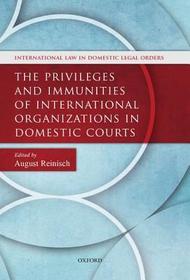
The Privileges and Immunities of International Organizations in Domestic Courts
Sorozatcím: International Law and Domestic Legal Orders;
-
10% KEDVEZMÉNY?
- A kedvezmény csak az 'Értesítés a kedvenc témákról' hírlevelünk címzettjeinek rendeléseire érvényes.
- Kiadói listaár GBP 147.50
-
66 596 Ft (63 425 Ft + 5% áfa)
Az ár azért becsült, mert a rendelés pillanatában nem lehet pontosan tudni, hogy a beérkezéskor milyen lesz a forint árfolyama az adott termék eredeti devizájához képest. Ha a forint romlana, kissé többet, ha javulna, kissé kevesebbet kell majd fizetnie.
- Kedvezmény(ek) 10% (kb. 6 659 Ft)
- Kedvezményes ár 59 937 Ft (57 083 Ft + 5% áfa)
Iratkozzon fel most és részesüljön kedvezőbb árainkból!
Feliratkozom
66 596 Ft

Beszerezhetőség
Megrendelésre a kiadó utánnyomja a könyvet. Rendelhető, de a szokásosnál kicsit lassabban érkezik meg.
Why don't you give exact delivery time?
A beszerzés időigényét az eddigi tapasztalatokra alapozva adjuk meg. Azért becsült, mert a terméket külföldről hozzuk be, így a kiadó kiszolgálásának pillanatnyi gyorsaságától is függ. A megadottnál gyorsabb és lassabb szállítás is elképzelhető, de mindent megteszünk, hogy Ön a lehető leghamarabb jusson hozzá a termékhez.
A termék adatai:
- Kiadó OUP Oxford
- Megjelenés dátuma 2013. szeptember 12.
- ISBN 9780199679409
- Kötéstípus Keménykötés
- Terjedelem396 oldal
- Méret 234x157x30 mm
- Súly 752 g
- Nyelv angol 0
Kategóriák
Rövid leírás:
National courts may refer to the decisions of foreign or international courts in their judgments. This book presents an empirical study of this transnational judicial dialogue through a detailed analysis of domestic case law on the privileges and immunities of international organizations.
TöbbHosszú leírás:
International organizations are increasingly operating across borders and engaging in legal transactions in virtually all jurisdictions. This makes, familiarity with the applicable law and practice imperative for both international organizations and those who engage in legal relations with them. Furthermore, the issue of whether, how, and to what extent domestic courts take into account decisions of foreign and international courts and tribunals in their own decision-making has become increasingly important in recent years. This book provides a comprehensive empirical study of this transnational judicial dialogue, focusing on the law and practice of domestic jurisdictions concerning the legal personality, privileges, and immunities of international organizations. It presents a selection of detailed country-by-country studies, examining the manner of judicial dialogue across domestic jurisdictions, and between national and international courts.
The approach taken in this book intersects with three highly topical areas of international legal scholarship: the rapidly evolving law of international institutions; the burgeoning research into the role of domestic courts in the international legal system; and the recent rise of empirically-oriented legal scholarship. Utilizing OUP's International Law in Domestic Courts database, the book presents analysis of little-known cases which have real international significance, illustrating the impact and extent of transnational judicial dialogue in the international legal system. The book provides important perspectives on the evolution and status of the law of immunity of international organizations, and contributes to the understanding of relationships between national courts, and between national and international courts.
Tartalomjegyzék:
Transnational Judicial Conversations on the Personality, Privileges and Immunities of International Organizations An Introduction
Argentina
Austria
Belgium
Canada
France
Germany
Greece
India
Italy
Japan
Netherlands
Philippines
Russian Federation
Switzerland
United Kingdom
United States
Conclusion

