

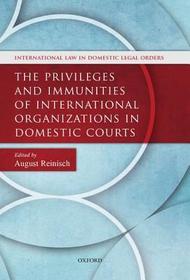
The Privileges and Immunities of International Organizations in Domestic Courts
Series: International Law and Domestic Legal Orders;
- Publisher's listprice GBP 147.50
-
66 596 Ft (63 425 Ft + 5% VAT)
The price is estimated because at the time of ordering we do not know what conversion rates will apply to HUF / product currency when the book arrives. In case HUF is weaker, the price increases slightly, in case HUF is stronger, the price goes lower slightly.
- Discount 10% (cc. 6 659 Ft off)
- Discounted price 59 937 Ft (57 083 Ft + 5% VAT)
Subcribe now and take benefit of a favourable price.
Subscribe
66 596 Ft

Availability
printed on demand
Why don't you give exact delivery time?
Delivery time is estimated on our previous experiences. We give estimations only, because we order from outside Hungary, and the delivery time mainly depends on how quickly the publisher supplies the book. Faster or slower deliveries both happen, but we do our best to supply as quickly as possible.
Product details:
- Publisher OUP Oxford
- Date of Publication 12 September 2013
- ISBN 9780199679409
- Binding Hardback
- No. of pages396 pages
- Size 234x157x30 mm
- Weight 752 g
- Language English 0
Categories
Short description:
National courts may refer to the decisions of foreign or international courts in their judgments. This book presents an empirical study of this transnational judicial dialogue through a detailed analysis of domestic case law on the privileges and immunities of international organizations.
MoreLong description:
International organizations are increasingly operating across borders and engaging in legal transactions in virtually all jurisdictions. This makes, familiarity with the applicable law and practice imperative for both international organizations and those who engage in legal relations with them. Furthermore, the issue of whether, how, and to what extent domestic courts take into account decisions of foreign and international courts and tribunals in their own decision-making has become increasingly important in recent years. This book provides a comprehensive empirical study of this transnational judicial dialogue, focusing on the law and practice of domestic jurisdictions concerning the legal personality, privileges, and immunities of international organizations. It presents a selection of detailed country-by-country studies, examining the manner of judicial dialogue across domestic jurisdictions, and between national and international courts.
The approach taken in this book intersects with three highly topical areas of international legal scholarship: the rapidly evolving law of international institutions; the burgeoning research into the role of domestic courts in the international legal system; and the recent rise of empirically-oriented legal scholarship. Utilizing OUP's International Law in Domestic Courts database, the book presents analysis of little-known cases which have real international significance, illustrating the impact and extent of transnational judicial dialogue in the international legal system. The book provides important perspectives on the evolution and status of the law of immunity of international organizations, and contributes to the understanding of relationships between national courts, and between national and international courts.
Table of Contents:
Transnational Judicial Conversations on the Personality, Privileges and Immunities of International Organizations An Introduction
Argentina
Austria
Belgium
Canada
France
Germany
Greece
India
Italy
Japan
Netherlands
Philippines
Russian Federation
Switzerland
United Kingdom
United States
Conclusion

