

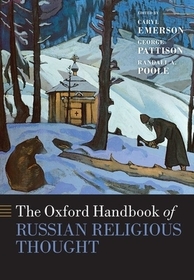
The Oxford Handbook of Russian Religious Thought
Sorozatcím: Oxford Handbooks;
-
10% KEDVEZMÉNY?
- A kedvezmény csak az 'Értesítés a kedvenc témákról' hírlevelünk címzettjeinek rendeléseire érvényes.
- Kiadói listaár GBP 157.50
-
71 111 Ft (67 725 Ft + 5% áfa)
Az ár azért becsült, mert a rendelés pillanatában nem lehet pontosan tudni, hogy a beérkezéskor milyen lesz a forint árfolyama az adott termék eredeti devizájához képest. Ha a forint romlana, kissé többet, ha javulna, kissé kevesebbet kell majd fizetnie.
- Kedvezmény(ek) 10% (cc. 7 111 Ft off)
- Kedvezményes ár 64 000 Ft (60 953 Ft + 5% áfa)
Iratkozzon fel most és részesüljön kedvezőbb árainkból!
Feliratkozom
71 111 Ft

Beszerezhetőség
Megrendelésre a kiadó utánnyomja a könyvet. Rendelhető, de a szokásosnál kicsit lassabban érkezik meg.
Why don't you give exact delivery time?
A beszerzés időigényét az eddigi tapasztalatokra alapozva adjuk meg. Azért becsült, mert a terméket külföldről hozzuk be, így a kiadó kiszolgálásának pillanatnyi gyorsaságától is függ. A megadottnál gyorsabb és lassabb szállítás is elképzelhető, de mindent megteszünk, hogy Ön a lehető leghamarabb jusson hozzá a termékhez.
A termék adatai:
- Kiadó OUP Oxford
- Megjelenés dátuma 2020. szeptember 4.
- ISBN 9780198796442
- Kötéstípus Keménykötés
- Terjedelem742 oldal
- Méret 249x180x48 mm
- Súly 1484 g
- Nyelv angol 18
Kategóriák
Rövid leírás:
The Oxford Handbook of Russian Religious Thought is an authoritative new reference and interpretive volume detailing the origins, development, and influence of one of the richest aspects of Russian cultural and intellectual life - its religious ideas.
TöbbHosszú leírás:
The Oxford Handbook of Russian Religious Thought is an authoritative new reference and interpretive volume detailing the origins, development, and influence of one of the richest aspects of Russian cultural and intellectual life - its religious ideas. After setting the historical background and context, the Handbook follows the leading figures and movements in modern Russian religious thought through a period of immense historical upheavals, including seventy years of officially atheist communist rule and the growth of an exiled diaspora with, e.g., its journal The Way. Therefore the shape of Russian religious thought cannot be separated from long-running debates with nihilism and atheism. Important thinkers such as Losev and Bakhtin had to guard their words in an environment of religious persecution, whilst some views were shaped by prison experiences. Before the Soviet period, Russian national identity was closely linked with religion - linkages which again are being forged in the new Russia. Relevant in this connection are complex relationships with Judaism. In addition to religious thinkers such as Philaret, Chaadaev, Khomiakov, Kireevsky, Soloviev, Florensky, Bulgakov, Berdyaev, Shestov, Frank, Karsavin, and Alexander Men, the Handbook also looks at the role of religion in aesthetics, music, poetry, art, film, and the novelists Dostoevsky and Tolstoy. Ideas, institutions, and movements discussed include the Church academies, Slavophilism and Westernism, theosis, the name-glorifying (imiaslavie) controversy, the God-seekers and God-builders, Russian religious idealism and liberalism, and the Neopatristic school. Occultism is considered, as is the role of tradition and the influence of Russian religious thought in the West.
...extensive and ground-breaking...
Tartalomjegyzék:
FOREWORD
INTRODUCTION
PART I HISTORICAL CONTEXTS
Christianity in Rus' and Muscovy
The Orthodox Church and Religious Life in Imperial Russia
The Orthodox Church and Religion in Revolutionary Russia, 1894-1924
Russian Religious Life in the Soviet Era
PART II THE NINETEENTH CENTURY
The Theological-Aesthetic Vision of Metropolitan Filaret
Russian Orthodox Thought in the Church's Clerical Academies
Petr Chaadaev and the Slavophile-Westernizer Debate
Slavophilism and the Origins of Russian Religious Philosophy
Nihilism
Dostoevsky
Tolstoy
Vladimir Soloviev as a Religious Philosopher
PART III THE RELIGIOUS-PHILOSOPHICAL RENAISSANCE, 1900-1922
God-seeking, God-building, and the New Religious Consciousness
Theosis in Early Twentieth-Century Russian Religious Thought
The Liberalism of Russian Religious Idealism
Sergei Bulgakov's Intellectual Journey, 1900-1922
Pavel Florensky: At the Boundary of Immanence and Transcendence
The Personalism of Nikolai Berdiaev
The Name-Glorifiers (Imiaslavie) Controversy
Judaism and Russian Religious Thought
PART IV ART IN RUSSIAN RELIGIOUS THOUGHT
Russian Religious Aesthetics in the First Half of the Twentieth Century
'Musical Metaphysics' in Late Imperial Russia
Furor Liturgicus: The Religious Concerns of Russian Poetry
The Icon and Visual Arts at the Time of the Russian Religious Renaissance
PART V RUSSIAN RELIGIOUS THOUGHT ABROAD
The Way, The Journal of the Russian Emigration (1925-1940)
Berdyaev and Christian Existentialism
Lev Shestov: The Meaning of Life and the Critique of Scientific Knowledge
Sergius Bulgakov in Exile: The Flowering of a Systematic Theologian
Semyon Frank
Lev Karsavin
Varieties of Neopatristics: Georges Florovsky, Vladimir Lossky, and Alexander Schmemann
'The Work': The Teachings of G. I. Gurdieff and P. D. Ouspensky in Russia and Beyond
PART VI RELIGIOUS THOUGHT IN SOVIET RUSSIA
Alexei Losev: 'The Last Russian Philosopher' of the Silver Age
Religious Thought and Experience in the Prison Camps
Seeking God and Spiritual Salvation in Russian Cinema
Mikhail Bakhtin
Alexander Men and Russian Religious Thought in the Post-Soviet Situation
PART VII ASSESSMENTS
Tradition in the Russian Theological World
The Influence of Russian Religious Thought on Western Theology in the Twentieth Century
The Tradition of Christian Thought in the History of Russian Culture

