

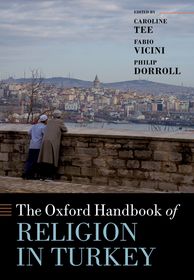
The Oxford Handbook of Religion in Turkey
Sorozatcím: Oxford Handbooks;
-
10% KEDVEZMÉNY?
- A kedvezmény csak az 'Értesítés a kedvenc témákról' hírlevelünk címzettjeinek rendeléseire érvényes.
- Kiadói listaár GBP 135.00
-
60 952 Ft (58 050 Ft + 5% áfa)
Az ár azért becsült, mert a rendelés pillanatában nem lehet pontosan tudni, hogy a beérkezéskor milyen lesz a forint árfolyama az adott termék eredeti devizájához képest. Ha a forint romlana, kissé többet, ha javulna, kissé kevesebbet kell majd fizetnie.
- Kedvezmény(ek) 10% (cc. 6 095 Ft off)
- Kedvezményes ár 54 857 Ft (52 245 Ft + 5% áfa)
Iratkozzon fel most és részesüljön kedvezőbb árainkból!
Feliratkozom
60 952 Ft

Beszerezhetőség
Becsült beszerzési idő: A Prosperónál jelenleg nincsen raktáron, de a kiadónál igen. Beszerzés kb. 3-5 hét..
A Prosperónál jelenleg nincsen raktáron.
Why don't you give exact delivery time?
A beszerzés időigényét az eddigi tapasztalatokra alapozva adjuk meg. Azért becsült, mert a terméket külföldről hozzuk be, így a kiadó kiszolgálásának pillanatnyi gyorsaságától is függ. A megadottnál gyorsabb és lassabb szállítás is elképzelhető, de mindent megteszünk, hogy Ön a lehető leghamarabb jusson hozzá a termékhez.
A termék adatai:
- Kiadó OUP USA
- Megjelenés dátuma 2026. június 30.
- ISBN 9780197624883
- Kötéstípus Keménykötés
- Terjedelem696 oldal
- Méret 250x182x55 mm
- Súly 1152 g
- Nyelv angol 700
Kategóriák
Rövid leírás:
Since its foundation in 1923, the Republic of Turkey has had a complex and often misunderstood relationship with religion. Despite the constitutional secularism implemented by its founders, Islam has been resurgent in Turkey in the 21st century, and the relative openness of Turkish society has cultivated vibrant religious (and non-religious) minority communities.
The Oxford Handbook of Religion in Turkey offers a comprehensive analysis of the ways in which religion is understood and experienced in Turkey, with thematic sections dealing with religion and the state, theological trends, religious minorities, culture, and modern intellectual movements. With co-editors in chief specializing in religious studies, theology, and anthropology, the Handbook provides the definitive reference work in this growing field.
Hosszú leírás:
Since its foundation in 1923, the Republic of Turkey has had a complex and often misunderstood relationship with religion. The constitutional la--cit-- implemented by its founders is unique in a Muslim context, and although the majority of the population identifies as Muslim, the state recognizes no official religion. Despite this secular stance, Islam has been resurgent in Turkey in the 21st century. Moreover, the relative openness of Turkish society has cultivated vibrant religious (and non-religious) minority communities, placing it at the forefront of global demographic changes in religion. As a result, Turkey has fostered a perennial dynamism among expressions of religious practice, belief, and identity.
The Oxford Handbook of Religion in Turkey offers a comprehensive analysis of the ways in which religion is understood, experienced, and contested in contemporary Turkey. The Handbook is arranged into thematic sections dealing with religion and the origin of the state, theological trends in the early republic, Islam in rural and urban settings, religious minorities, religion and culture, religion and politics, and modern intellectual and religious trends. Though this is a seemingly narrow topic, the subject of religion in Turkey attracts considerable interest both within and outside of the academy. Paradoxically, the study of modern Turkish theology is still in its infancy in the Western academy, not only because of the inaccessibility of the sources to non-Turkish speakers, but also because of an over-emphasis on the study of Turkish secularism, to the detriment of the study of religion itself. The Handbook thus represents an important intervention by presenting themes from modern Turkish theology, while opening the field of religious and Islamic studies to include more voices from Turkey. With co-editors in chief specializing in religious studies, theology, and anthropology, the Handbook provides the definitive reference work in this growing field.
Tartalomjegyzék:
1. 100 Years of Religion in Turkey: Voices from the Center and the Margins
Caroline Tee, Fabio Vicini, and Philip Dorroll
Part I. Religion Between Ottoman Empire and Turkish Republic
2. Modern Islam and Reform in the Late Ottoman Empire
Susan Gunasti
3. Beyond the Dichotomy of Secular and Religious: Turkish Secularism, the State, and the Diyanet
Berna Zengin Arslan
4. Religious Minorities and the Construction of Turkish Islam
Markus Dre--ler
5. Kurdish Medrese in Ottoman and Republican Times
Martin van Bruinessen
6. A History of the Anatolian Kizilbas-Alevis (c.16th to early 20th century)
Janina Karolewski and Benjamin Weineck
Part II. Theological and Intellectual Trends in the 20th Century
7. 20th Century Turkish Theology: Remaking and Renewal
Philip Dorroll
8. Sufism in Republican Turkey
Mark Soileau
9. Islamism in Republican Turkey
Katerina Dalacoura
10. The Secular and Religious: Or, What the Curious Lexicon of Turkish Neo-Spiritualism Might Reveal
Kutlughan Soyubol
Part III. Religious Life Between Rural and Urban Geographies
11. Performing Piety: Religion and Rural Life in Turkey
Kimberly Hart
12. Cemaat and the city: Muslim Reconstruction in Modern Turkey
Fabio Vicini
13. Urban Relations of the Sacred: Building and Storytelling in Republican Turkey
Timur Hammond
14. Twelver Shi'a in Turkey
Stefan Williamson Fa
Part IV. Religious Minority Groups: Histories and Experiences
15. Armenians in Turkey
Talin Suciyan
16. The Syrian Orthodox Community in Contemporary Turkey and the Diaspora
Kerith Miller
17. Eastern Orthodox Christians and the Ecumenical Patriarch of Constantinople
Anna Maria Beylunioglu
18. The Ezidis of Turkey
Christine Robins
19. The Jewish Community in Modern and Contemporary Turkey
Ozgur Kaymak
Part V. Religion, Art, and Culture
20. Religion and Literature in Ottoman and Republican Turkey, 1850-1960
Laurent Mignon
21. Hagia Sophia and Universal Power from Byzantium to the Modern World
Bissera V. Pentcheva
22. Islam and Music in Turkey
Harun Korkmaz and Martin Stokes
23. Screening Piety: Religion in Turkish Film and Television Drama
Petra de Bruijn
Part VI. Islam and Politics
24. Fethullah G--len and the Hizmet Movement: Power, Controversy, and the 'Good Muslim' Paradigm
Kim Shively and Caroline Tee
25. Alevism and the Politics of Religious Freedom
Jeremy F. Walton and --i--ek Ilengiz
26. The Directorate of Religious Affairs: Family-related Religious Guidance Bureaus, and Female Religious Authority in Turkey
Hikmet Kocamaner
27. From Cellhouses to the Parliament: Kurdish Hizbullah's Transformation and the AKP Governance in Turkey
Mashuq Kurt
Part VII. Transformations of Modern Turkey
28. Locating Women and the Expansion of Islamic Morality in the New Turkey: Anthropological and Sociological Perspectives
Serta-- Sehlikoglu and Merve K--t--k-Kuris
29. The LGBTI Community and Religious Context in Turkey
Cenk --zbay
30. Turkey, Islam, and Turks in Europe: Postmigration Transnationalism
Thijl Sunier
31. Contemporary Languages of Science and Islam in Turkey: The Qur'an, Evolution, and Creationism
Yunus Dogan Telliel
Part VIII. Contemporary Religious and Intellectual Trends
32. Islamic Feminism in Turkey
Feyza Burak-Adli
33. Public Islamic Intellectuals in Turkey
Gokhan Bacik
34. Turkey's Religious Nones: Atheists, Deists, or Post-Muslims?
Pierre Hecker
35. 21st Century Turkish Theology: Currents of Continuity and Contestation
Taraneh R. Wilkinson
Index

