

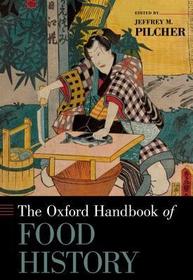
The Oxford Handbook of Food History
Sorozatcím: Oxford Handbooks;
-
10% KEDVEZMÉNY?
- A kedvezmény csak az 'Értesítés a kedvenc témákról' hírlevelünk címzettjeinek rendeléseire érvényes.
- Kiadói listaár GBP 177.50
-
80 141 Ft (76 325 Ft + 5% áfa)
Az ár azért becsült, mert a rendelés pillanatában nem lehet pontosan tudni, hogy a beérkezéskor milyen lesz a forint árfolyama az adott termék eredeti devizájához képest. Ha a forint romlana, kissé többet, ha javulna, kissé kevesebbet kell majd fizetnie.
- Kedvezmény(ek) 10% (kb. 8 014 Ft)
- Kedvezményes ár 72 127 Ft (68 693 Ft + 5% áfa)
Iratkozzon fel most és részesüljön kedvezőbb árainkból!
Feliratkozom
80 141 Ft

Beszerezhetőség
Megrendelésre a kiadó utánnyomja a könyvet. Rendelhető, de a szokásosnál kicsit lassabban érkezik meg.
Why don't you give exact delivery time?
A beszerzés időigényét az eddigi tapasztalatokra alapozva adjuk meg. Azért becsült, mert a terméket külföldről hozzuk be, így a kiadó kiszolgálásának pillanatnyi gyorsaságától is függ. A megadottnál gyorsabb és lassabb szállítás is elképzelhető, de mindent megteszünk, hogy Ön a lehető leghamarabb jusson hozzá a termékhez.
A termék adatai:
- Kiadó OUP USA
- Megjelenés dátuma 2012. november 8.
- ISBN 9780199729937
- Kötéstípus Keménykötés
- Terjedelem536 oldal
- Méret 249x180x40 mm
- Súly 1089 g
- Nyelv angol 0
Kategóriák
Rövid leírás:
The Oxford Handbook of Food History places existing works of food history in historiographical context, crossing disciplinary, chronological, and geographic boundaries, while also suggesting new routes for future research. The twenty-seven essays in this book are organized into five basic sections: historiography and disciplinary approaches as well as the production, circulation, and consumption of food.
TöbbHosszú leírás:
The historical study of food, culture, and society has become established within the academy based on a generation of high-quality scholarship. Following the foundational work of the French Annales school, the International Committee for the Research into European Food History and the Institut Europeen d'Histoire et des Cultures de l'Alimentation have conducted wide-ranging research, particularly on the changes brought about by culinary modernization. In the United States, the ascendancy of cultural history in the 1990s encouraged young scholars to write dissertations on food-related topics. Despite the existence of at least four major scholarly journals focused on food, the field still lacks a solid foundation of historiographical writing. As a result, innovative early approaches to commodity chains, ethnic identities, and culinary transformation have become repetitive. Meanwhile, scholars are often unaware of relevant literature when it does not directly relate to their particular national and chronological focus.
The Oxford Handbook of Food History places existing works in historiographical context, crossing disciplinary, chronological, and geographic boundaries, while also suggesting new routes for future research. The twenty-seven essays in this book are organized into five basic sections: historiography and disciplinary approaches as well as the production, circulation, and consumption of food. Chapters on historiography examine the French Annales school, political history, the cultural turn, labor, and public history. Disciplinary methods that have contributed significantly to the history of food including anthropology, sociology, geography, the emerging Critical Nutrition Studies. The final chapter in this section explores the uses of food in the classroom. The production section encompasses agriculture, pastoralism, and the environment; using cookbooks as historical documents; food and empire; industrial foods; and fast food. Circulation is examined through the lenses of human mobility, chronological frames, and food regimes, along with case studies of the medieval spice trade, the Columbian exchange, and modern culinary tourism. Finally, the consumption section focuses on communities that arise through the sharing of food, including religion, race and ethnicity, national cuisines, and social movements.
vital and timely gathering of scholarship ... The general public will find this collection a stimulating introduction to the study of food and foodways. Scholars who work on food-related topics will find these essays a thoughtful assessment of the field from multiple perspectives. The range and depth of the essays within this volume reveal the maturity of food studies as a field as well as the exciting avenues available for further analysis.
Tartalomjegyzék:
Introduction
Jeffrey M. Pilcher
Part I. Food Histories
1. Food and the Annales School, Sydney Watts
2. Political Histories of Food, Enrique Ochoa
3. Cultural Histories of Food, Jeffrey M. Pilcher
4. Labor Histories of Food, Tracey Deutsch
5. Public Histories of Food, Rayna Green
Part II. Food Studies
6. Gendering Food, Carole Counihan
7. Anthropology of Food, R. Kenji Tierney and Emiko Ohnuki-Tierney
8. Sociology of Food, Sierra Burnett Clark and Krishnendu Ray
9. Geography of Food, Bertie Mandelblatt
10. Critical Nutrition Studies, Charlotte Biltekoff
11. Teaching with Food, Jonathan Deutsch and Jeffrey Miller
Part III. The Means of Production
12. Agricultural Production and Environmental History, Sterling Evans
13. Cookbooks as Historical Documents, Ken Albala
14. Empires of Food, Jayeeta Sharma
15. Industrial Food, Gabriella M. Petrick
16. Fast Food, Steve Penfold
Part IV. The Circulation of Food
17. Food, Mobility, and World History, Donna R. Gabaccia
18. The Medieval Spice Trade, Paul Freedman
19. The Columbian Exchange, Rebecca Earle
20. Food, Time, and History, Elias Mandala
21. Food Regimes, André Magnan
22. Culinary Tourism, Lucy Long
Part V. Communities of Consumption
23. Food and Religion, Corrie E. Norman
24. Food, Race, and Ethnicity, Yong Chen
25. National Cuisines, Alison K. Smith
26. Food and Ethical Consumption, Rachel Ankeny
27. Food and Social Movements, Warren Belasco

