

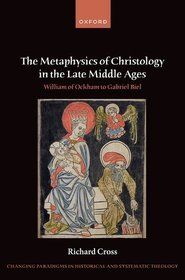
The Metaphysics of Christology in the Late Middle Ages
William of Ockham to Gabriel Biel
Sorozatcím: Changing Paradigms in Historical and Systematic Theology;
-
10% KEDVEZMÉNY?
- A kedvezmény csak az 'Értesítés a kedvenc témákról' hírlevelünk címzettjeinek rendeléseire érvényes.
- Kiadói listaár GBP 93.00
-
41 989 Ft (39 990 Ft + 5% áfa)
Az ár azért becsült, mert a rendelés pillanatában nem lehet pontosan tudni, hogy a beérkezéskor milyen lesz a forint árfolyama az adott termék eredeti devizájához képest. Ha a forint romlana, kissé többet, ha javulna, kissé kevesebbet kell majd fizetnie.
- Kedvezmény(ek) 10% (kb. 4 198 Ft)
- Kedvezményes ár 37 791 Ft (35 991 Ft + 5% áfa)
Iratkozzon fel most és részesüljön kedvezőbb árainkból!
Feliratkozom
41 989 Ft

Beszerezhetőség
Megrendelésre a kiadó utánnyomja a könyvet. Rendelhető, de a szokásosnál kicsit lassabban érkezik meg.
Why don't you give exact delivery time?
A beszerzés időigényét az eddigi tapasztalatokra alapozva adjuk meg. Azért becsült, mert a terméket külföldről hozzuk be, így a kiadó kiszolgálásának pillanatnyi gyorsaságától is függ. A megadottnál gyorsabb és lassabb szállítás is elképzelhető, de mindent megteszünk, hogy Ön a lehető leghamarabb jusson hozzá a termékhez.
A termék adatai:
- Kiadó OUP Oxford
- Megjelenés dátuma 2023. augusztus 11.
- ISBN 9780198880646
- Kötéstípus Keménykötés
- Terjedelem342 oldal
- Méret 240x165x25 mm
- Súly 684 g
- Nyelv angol 411
Kategóriák
Rövid leírás:
This book explores how a standard framework for Christological opinion based on the thought of John Duns Scotus and Hervaeus Natalis was established in the late medieval period. It also examines several alternative positions, providing an essential background for the understanding of Reformation Christology.
TöbbHosszú leírás:
The late middle ages was a period of great speculative innovation in Christology, within the framework of a standard Christological opinion established by the Franciscan John Duns Scotus and the Dominican Hervaeus Natalis. According to this view, the Incarnation consists in some kind of dependence relationship between an individual human nature and a divine person. The Metaphysics of Christology in the Late Middle Ages: William of Ockham to Gabriel Biel explores ways in which this standard opinion was developed in the late middle ages. Theologians offered various proposals about the nature of the relationship--as a categorial relation, or an absolute quality, or even just the divine will.
Author Richard Cross also considers alternative positions: Peter Auriol's claim that the divine person is a 'quidditative termination' of the human nature; the homo assumptus theology of John Wyclif and Jan Hus; and the retrieval of a truly Thomistic Christology in the fifteenth century in the thought of John Capreolus and Denys the Carthusian. The fourteenth and fifteenth centuries were pre-eminently the age of nominalism, and this book examines the impact of nominalism on Christological discussions, as well as the development of Thomist and Scotist theology in the period. It also provides essential background for the correct understanding of Reformation Christology.
Admittedly, this study illustrates the challenges posed by the original sources, but the reader will find it worth the effort.
Tartalomjegyzék:
Abbreviations
Introduction: The character of late medieval Christology
I: The opinio communis
The tradition of Hervaeus Natalis
Oxford after Scotus
The tradition of Scotus
The opinio communis without real relations
Christological semantics and the impact of nominalism
II: Alternative trajectories
Peter Auriol
Unions by perichoresis and activity
Homo assumptus Christologies
The recovery of a Thomist tradition
Conclusion: Some programmes for Christology
Bibliography
Index

