

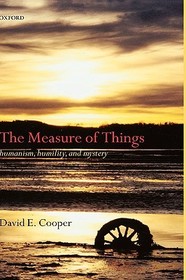
The Measure of Things
Humanism, Humility, and Mystery
-
10% KEDVEZMÉNY?
- A kedvezmény csak az 'Értesítés a kedvenc témákról' hírlevelünk címzettjeinek rendeléseire érvényes.
- Kiadói listaár GBP 160.00
-
72 240 Ft (68 800 Ft + 5% áfa)
Az ár azért becsült, mert a rendelés pillanatában nem lehet pontosan tudni, hogy a beérkezéskor milyen lesz a forint árfolyama az adott termék eredeti devizájához képest. Ha a forint romlana, kissé többet, ha javulna, kissé kevesebbet kell majd fizetnie.
- Kedvezmény(ek) 10% (kb. 7 224 Ft)
- Kedvezményes ár 65 016 Ft (61 920 Ft + 5% áfa)
Iratkozzon fel most és részesüljön kedvezőbb árainkból!
Feliratkozom
72 240 Ft

Beszerezhetőség
Megrendelésre a kiadó utánnyomja a könyvet. Rendelhető, de a szokásosnál kicsit lassabban érkezik meg.
Why don't you give exact delivery time?
A beszerzés időigényét az eddigi tapasztalatokra alapozva adjuk meg. Azért becsült, mert a terméket külföldről hozzuk be, így a kiadó kiszolgálásának pillanatnyi gyorsaságától is függ. A megadottnál gyorsabb és lassabb szállítás is elképzelhető, de mindent megteszünk, hogy Ön a lehető leghamarabb jusson hozzá a termékhez.
A termék adatai:
- Kiadó OUP Oxford
- Megjelenés dátuma 2002. október 24.
- ISBN 9780198238270
- Kötéstípus Keménykötés
- Terjedelem384 oldal
- Méret 242x163x25 mm
- Súly 694 g
- Nyelv angol 0
Kategóriák
Rövid leírás:
David Cooper explores and defends the view that a reality independent of human perspectives is necessarily indescribable, a 'mystery'. Other views are shown to be hubristic. Humanists, for whom 'man is the measure' of reality, exaggerate our capacity to live without the sense of an independent measure. Absolutists, who proclaim our capacity to know an independent reality, exaggerate our cognitive powers. In this highly original book Cooper restores to philosophy a proper appreciation of mystery - that is what provides a measure of our beliefs and conduct.
TöbbHosszú leírás:
Philosophers, both western and eastern, have long been divided between 'humanists', for whom 'man is the measure of things', and their opponents, who claim that there is a way, in principle knowable and describable, that the world anyway is, independent of human perspectives and interests.
The early chapters of The Measure of Things chart the development of humanism from medieval times, through the Renaissance, Enlightenment and Romantic periods, to its most sophisticated, twentieth-century form, 'existential humanism'. Cooper does not identify this final position with that of any particular philosopher, though it is closely related to those of Heidegger, Merleau-Ponty and the later Wittgenstein. Among the earlier figures discussed are William of Ockham, Kant, Herder, Nietzsche and William James.
Having rejected attempts by contemporary advocates of modest or non-metaphysical realism to dissolve the opposition between humanism and its 'absolutist' rival, Cooper moves on to an adjudication of that rivality. Prompted by the pervasive rhetoric of hubris that the rivals direct against one another, he argues, in an original manner, that the rival positions are indeed guilty of lack of humility. Absolutists - whether defenders of 'The Given' or scientific realists - exaggerate our capacity to ascend out of our 'engaged' perspectives to an objective account of the world. Humanists, conversely, exaggerate our capacity to live without a sense of our subjection to a measure independent of our own perspectives.
The only escape, Cooper maintains, from the impasse reached when humanism and absolutism are both rejected, lies in a doctrine of mystery. There is a reality independent of 'the human contribution', but it is necessarily ineffable. Drawing in a novel way upon the Buddhist conception of 'emptiness' and Heidegger's later writings, the final chapters defend the notion of mystery, distinguish the doctrine advanced from that of transcendental idealism, and propose that it is only through appreciation of mystery that measure and warrant may be provided for our beliefs and conduct.
...rich, subtle and hugely ambitious book...Grand scheme, rich in detail, by turns meditative and aggressively analytic, unhurried yet purposive, it is, in short, a book of the highest insight about metaphysics and the meaning of life...prospective readers should notunderestimate the task of reading this book. It is a rich diet and a demanding read that will require close and repeated attention. It brings proportionate rewards.
Tartalomjegyzék:
Preface
Introduction
Self-assertion: from 'Ockhamism' to the Renaissance
Reason and Agency: Enlightenment, Kant and Romanticism
Prometheanism Unbound: from Marx and Nietzsche to Pragmatism
Existential Humanism
Interlude: Rival Humanisms
Belief, Posture and Humility
The Hubris of Absolutism
The Hubris of Humanism (1)
The Hubris of Humanism (2)
Mystery
Emptiness and Mystery
Mystery and Measure
Index

