

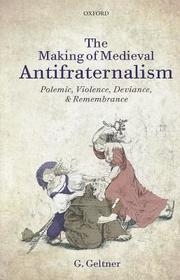
The Making of Medieval Antifraternalism
Polemic, Violence, Deviance, and Remembrance
-
10% KEDVEZMÉNY?
- A kedvezmény csak az 'Értesítés a kedvenc témákról' hírlevelünk címzettjeinek rendeléseire érvényes.
- Kiadói listaár GBP 142.50
-
68 079 Ft (64 837 Ft + 5% áfa)
Az ár azért becsült, mert a rendelés pillanatában nem lehet pontosan tudni, hogy a beérkezéskor milyen lesz a forint árfolyama az adott termék eredeti devizájához képest. Ha a forint romlana, kissé többet, ha javulna, kissé kevesebbet kell majd fizetnie.
- Kedvezmény(ek) 10% (cc. 6 808 Ft off)
- Kedvezményes ár 61 271 Ft (58 353 Ft + 5% áfa)
Iratkozzon fel most és részesüljön kedvezőbb árainkból!
Feliratkozom
68 079 Ft

Beszerezhetőség
Megrendelésre a kiadó utánnyomja a könyvet. Rendelhető, de a szokásosnál kicsit lassabban érkezik meg.
Why don't you give exact delivery time?
A beszerzés időigényét az eddigi tapasztalatokra alapozva adjuk meg. Azért becsült, mert a terméket külföldről hozzuk be, így a kiadó kiszolgálásának pillanatnyi gyorsaságától is függ. A megadottnál gyorsabb és lassabb szállítás is elképzelhető, de mindent megteszünk, hogy Ön a lehető leghamarabb jusson hozzá a termékhez.
A termék adatai:
- Kiadó OUP Oxford
- Megjelenés dátuma 2012. április 5.
- ISBN 9780199639458
- Kötéstípus Keménykötés
- Terjedelem206 oldal
- Méret 241x160x19 mm
- Súly 476 g
- Nyelv angol
- Illusztrációk 4 black and white images 0
Kategóriák
Rövid leírás:
A case study in opposition to religious authority in the pre-modern period, Geltner treats a phenomenon known as antifraternalism from a fresh methodological and documentary perspective. He challenges many assumptions made about the early history of the mendicant orders, and the origins, scale, and scope of resistance to them.
TöbbHosszú leírás:
The mendicant orders-Augustinians, Carmelites, Dominicans, Franciscans, and several other groups-spread across Europe apace from the early thirteenth century, profoundly influencing numerous aspect of medieval life. But alongside their tremendous success, their members (friars) also encountered derision, scorn, and even violence. Such opposition, generally known as antifraternalism, is often seen as an ecclesiastical in-house affair or an ideological response to the brethren's laxity: both cases registering a moral decline symptomatic of a decadent church. Challenging the accuracy of these views, Geltner contends that the phenomenon exhibits a breadth of scope that on the one hand pushes it far beyond its accustomed boundaries, and on the other supports only tenuous links with Reformation or modern forms of anticlericalism.
Drawing from numerous sources, from theological treatises to poetry and criminal court records, Guy Geltner shows that people from all walks of life lambasted and occasionally assaulted the brethren, orchestrating detailed scenes of urban violence in the process. Their myriad motivations and diverse goals preclude us from associating antifraternalism with any one ideology or agenda, let alone allow us to brand many of its proponents as religious reformers. At the same time, he demonstrates the friars' active role in forging a medieval antifraternal tradition, not only by deviating from their founders' paths to varying degrees, but also by chronicling their suffering inter fideles and thus incorporating it into the orders' identity as the vanguard of Christianity. In doing so, Geltner illuminates a major chapter in Europe's social, urban, and religious history.
...an important book. It provides us with a significant corrective to an over-reliance on evidence from literary and theological works in understanding criticisms of the friars in the Middle Ages, and Geltner's argument for the contribution of the friars' own historiography to the development of the antifraternal tradition offers a whole new perspective on that process. Most important, however, Geltner brings this material together in a call for a comprehensive revision of how we think about antifraternalism.
Tartalomjegyzék:
Introduction
Part I: Words and Deeds: The World against the Friars
Polemic: False Apostles, False Seemings, False Starts
Violence: Friars under Fire
Part II: Deeds and Words: The Friars against Themselves
Deviance: Brethren Behaving Badly
Remembrance: Antifraternalism and Mendicant Identity
Conclusion: Antifraternalism, Anticlericalism, and Urban Discontent
Appendix One: Aggression against Mendicants until 1400
Appendix Two: Major Offenses and Punishments among Dominican Friars until 1400
Bibliography
Index

