

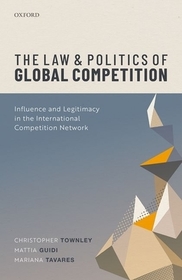
The Law and Politics of Global Competition
Influence and Legitimacy in the International Competition Network
-
10% KEDVEZMÉNY?
- A kedvezmény csak az 'Értesítés a kedvenc témákról' hírlevelünk címzettjeinek rendeléseire érvényes.
- Kiadói listaár GBP 115.00
-
54 941 Ft (52 325 Ft + 5% áfa)
Az ár azért becsült, mert a rendelés pillanatában nem lehet pontosan tudni, hogy a beérkezéskor milyen lesz a forint árfolyama az adott termék eredeti devizájához képest. Ha a forint romlana, kissé többet, ha javulna, kissé kevesebbet kell majd fizetnie.
- Kedvezmény(ek) 10% (cc. 5 494 Ft off)
- Kedvezményes ár 49 447 Ft (47 093 Ft + 5% áfa)
Iratkozzon fel most és részesüljön kedvezőbb árainkból!
Feliratkozom
54 941 Ft

Beszerezhetőség
Becsült beszerzési idő: A Prosperónál jelenleg nincsen raktáron, de a kiadónál igen. Beszerzés kb. 3-5 hét..
A Prosperónál jelenleg nincsen raktáron.
Why don't you give exact delivery time?
A beszerzés időigényét az eddigi tapasztalatokra alapozva adjuk meg. Azért becsült, mert a terméket külföldről hozzuk be, így a kiadó kiszolgálásának pillanatnyi gyorsaságától is függ. A megadottnál gyorsabb és lassabb szállítás is elképzelhető, de mindent megteszünk, hogy Ön a lehető leghamarabb jusson hozzá a termékhez.
A termék adatai:
- Kiadás sorszáma 1
- Kiadó OUP Oxford
- Megjelenés dátuma 2022. január 31.
- ISBN 9780198859789
- Kötéstípus Keménykötés
- Terjedelem400 oldal
- Méret 241x160x25 mm
- Súly 706 g
- Nyelv angol 242
Kategóriák
Rövid leírás:
This book hypothesises that the ICN's structures provide powerful influence mechanisms for strong NCAs and NGAs, over the weak; and 'competition experts' over wider state interests, discussing the legitimacy of this from a political and legal theory perspective, and analysing the ICN's effectiveness and efficiency.
TöbbHosszú leírás:
In its own words, the mission of the International Competition Network (the ICN) is to advocate the adoption of "superior standards and procedures in competition policy around the world, formulate proposals for procedural and substantive convergence, and seek to facilitate effective international cooperation to the benefit of member agencies, consumers and economies worldwide."
ICN members include nearly all competition authorities (NCAs) from around the world (over 100 of them). Since its inception, the ICN has also sought to enrich its discussions and outputs through the inclusion of non-governmental advisors (NGAs), principally large multi-nationals and the legal and economic professions. The ICN is a transnational network, set up by its members, largely without wider state input.
This book hypothesises that the ICN's formally neutral structures provide powerful influence mechanisms for strong NCAs and NGAs, over the weak; and 'competition experts' over wider state interests, discussing the legitimacy of this from a political and legal theory perspective, analysing the ICN's effectiveness and efficiency, and suggesting ways that the ICN can improve all three.
This study has important implications for the ICN itself, particularly as it launches its 'Third Decade Project', billed as a full self-evaluation. However, the story told here is also relevant to states and the wider regulatory community, due to the widespread use of transnational networks.
Clearly, this book is a must-read for legislators, regulators and researchers. It offers a remarkable critical perspective on an international forum that, until now, has received nothing but praise and has been promoted as a model to follow. Both in terms of the angles of approach and the method of analysis, one can only welcome the authors' approach and be convinced of the need to be more lucid about certain shortcomings of the International Competition Network (ICN).
This is a translated excerpt. The full original review can be found here: https://www.concurrences.com/en/review/issues/no-2-2022/livr
Tartalomjegyzék:
1. Introduction
2. Influence in the ICN: who seeks it, how do they do this, and why?
3. The International Competition Network's influence in the National Systems
4. Measuring interests and influence in the ICN (and of the ICN): a quantitative analysis
5. Legitimacy, effectiveness, and efficiency of the ICN
6. Conclusion
Appendix: Survey on participation in the International Competition Network

