

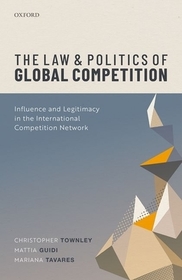
The Law and Politics of Global Competition
Influence and Legitimacy in the International Competition Network
- Publisher's listprice GBP 115.00
-
54 941 Ft (52 325 Ft + 5% VAT)
The price is estimated because at the time of ordering we do not know what conversion rates will apply to HUF / product currency when the book arrives. In case HUF is weaker, the price increases slightly, in case HUF is stronger, the price goes lower slightly.
- Discount 10% (cc. 5 494 Ft off)
- Discounted price 49 447 Ft (47 093 Ft + 5% VAT)
Subcribe now and take benefit of a favourable price.
Subscribe
54 941 Ft

Availability
Estimated delivery time: In stock at the publisher, but not at Prospero's office. Delivery time approx. 3-5 weeks.
Not in stock at Prospero.
Why don't you give exact delivery time?
Delivery time is estimated on our previous experiences. We give estimations only, because we order from outside Hungary, and the delivery time mainly depends on how quickly the publisher supplies the book. Faster or slower deliveries both happen, but we do our best to supply as quickly as possible.
Product details:
- Edition number 1
- Publisher OUP Oxford
- Date of Publication 31 January 2022
- ISBN 9780198859789
- Binding Hardback
- No. of pages400 pages
- Size 241x160x25 mm
- Weight 706 g
- Language English 242
Categories
Short description:
This book hypothesises that the ICN's structures provide powerful influence mechanisms for strong NCAs and NGAs, over the weak; and 'competition experts' over wider state interests, discussing the legitimacy of this from a political and legal theory perspective, and analysing the ICN's effectiveness and efficiency.
MoreLong description:
In its own words, the mission of the International Competition Network (the ICN) is to advocate the adoption of "superior standards and procedures in competition policy around the world, formulate proposals for procedural and substantive convergence, and seek to facilitate effective international cooperation to the benefit of member agencies, consumers and economies worldwide."
ICN members include nearly all competition authorities (NCAs) from around the world (over 100 of them). Since its inception, the ICN has also sought to enrich its discussions and outputs through the inclusion of non-governmental advisors (NGAs), principally large multi-nationals and the legal and economic professions. The ICN is a transnational network, set up by its members, largely without wider state input.
This book hypothesises that the ICN's formally neutral structures provide powerful influence mechanisms for strong NCAs and NGAs, over the weak; and 'competition experts' over wider state interests, discussing the legitimacy of this from a political and legal theory perspective, analysing the ICN's effectiveness and efficiency, and suggesting ways that the ICN can improve all three.
This study has important implications for the ICN itself, particularly as it launches its 'Third Decade Project', billed as a full self-evaluation. However, the story told here is also relevant to states and the wider regulatory community, due to the widespread use of transnational networks.
Clearly, this book is a must-read for legislators, regulators and researchers. It offers a remarkable critical perspective on an international forum that, until now, has received nothing but praise and has been promoted as a model to follow. Both in terms of the angles of approach and the method of analysis, one can only welcome the authors' approach and be convinced of the need to be more lucid about certain shortcomings of the International Competition Network (ICN).
This is a translated excerpt. The full original review can be found here: https://www.concurrences.com/en/review/issues/no-2-2022/livr
Table of Contents:
1. Introduction
2. Influence in the ICN: who seeks it, how do they do this, and why?
3. The International Competition Network's influence in the National Systems
4. Measuring interests and influence in the ICN (and of the ICN): a quantitative analysis
5. Legitimacy, effectiveness, and efficiency of the ICN
6. Conclusion
Appendix: Survey on participation in the International Competition Network

