

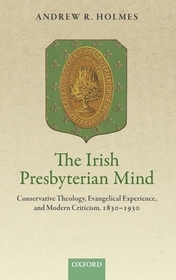
The Irish Presbyterian Mind
Conservative Theology, Evangelical Experience, and Modern Criticism, 1830-1930
-
10% KEDVEZMÉNY?
- A kedvezmény csak az 'Értesítés a kedvenc témákról' hírlevelünk címzettjeinek rendeléseire érvényes.
- Kiadói listaár GBP 105.00
-
47 407 Ft (45 150 Ft + 5% áfa)
Az ár azért becsült, mert a rendelés pillanatában nem lehet pontosan tudni, hogy a beérkezéskor milyen lesz a forint árfolyama az adott termék eredeti devizájához képest. Ha a forint romlana, kissé többet, ha javulna, kissé kevesebbet kell majd fizetnie.
- Kedvezmény(ek) 10% (kb. 4 740 Ft)
- Kedvezményes ár 42 667 Ft (40 635 Ft + 5% áfa)
Iratkozzon fel most és részesüljön kedvezőbb árainkból!
Feliratkozom
47 407 Ft

Beszerezhetőség
Becsült beszerzési idő: A Prosperónál jelenleg nincsen raktáron, de a kiadónál igen. Beszerzés kb. 3-5 hét..
A Prosperónál jelenleg nincsen raktáron.
Why don't you give exact delivery time?
A beszerzés időigényét az eddigi tapasztalatokra alapozva adjuk meg. Azért becsült, mert a terméket külföldről hozzuk be, így a kiadó kiszolgálásának pillanatnyi gyorsaságától is függ. A megadottnál gyorsabb és lassabb szállítás is elképzelhető, de mindent megteszünk, hogy Ön a lehető leghamarabb jusson hozzá a termékhez.
A termék adatai:
- Kiadó OUP Oxford
- Megjelenés dátuma 2018. október 16.
- ISBN 9780198793618
- Kötéstípus Keménykötés
- Terjedelem304 oldal
- Méret 243x164x23 mm
- Súly 616 g
- Nyelv angol 0
Kategóriák
Rövid leírás:
This study examines the complex religious and intellectual life of the Presbyterian Church in Ireland between 1830 and 1930. It considers the Church's response to the numerous challenges of modernity and the continued importance of conservative Protestantism in modern Northern Ireland.
TöbbHosszú leírás:
The Irish Presbyterian Mind considers how one protestant community responded to the challenges posed to traditional understandings of Christian faith between 1830 and 1930. Andrew R. Holmes examines the attitudes of the leaders of the Presbyterian Church in Ireland to biblical criticism, modern historical method, evolutionary science, and liberal forms of protestant theology. He explores how they reacted to developments in other Christian traditions, including the so-called 'Romeward' trend in the established Churches of England and Ireland and the 'Romanisation' of Catholicism. Was their response distinctively Presbyterian and Irish? How was it shaped by Presbyterian values, intellectual first principles, international denominational networks, identity politics, the expansion of higher education, and relations with other Christian denominations? The story begins in the 1830s when evangelicalism came to dominate mainstream Presbyterianism, the largest protestant denomination in present-day Northern Ireland. It ends in the 1920s with the exoneration of J. E. Davey, a professor in the Presbyterian College, Belfast, who was tried for heresy on accusations of being a 'modernist'. Within this timeframe, Holmes describes the formation and maintenance of a religiously-conservative intellectual community. At the heart of the interpretation is the interplay between the Reformed theology of the Westminster Confession of Faith and a commitment to common evangelical principles and religious experience that drew protestants together from various denominations. The definition of conservative within the Presbyterian Church in Ireland moved between these two poles and could take on different forms depending on time, geography, social class, and whether the individual was a minister or a member of the laity.
Often only seen in stereotypical terms, Irish Presbyterians have now found a worthy expositor in Andrew R. Holmes ... It turns out there were some remarkable and unexpected things going on in the Irish Presbyterian mind.
Tartalomjegyzék:
Abbreviations
Introduction: The Return of Religion and the Irish Presbyterian Mind
Confession, Subscription, and Revival, c.1800-1914
The Presbyterian Story: Church History, Church Government, and Unionist Identity Politics, 1830-1914
Mind and Matter: Mental and Natural Science
The Bible: Criticism, Hermeneutics, and Inspiration
Reconstruction, Revival, and the Triumph of Experience, 1914-1930
Conclusion
Bibliography

