

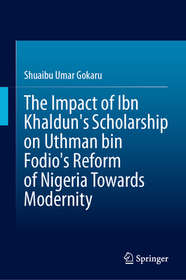
The Impact of Ibn Khaldun's Scholarship on Uthman bin Fodio's Reform of Nigeria Towards Modernity
-
12% KEDVEZMÉNY?
- Kiadói listaár EUR 106.99
-
41 790 Ft (39 800 Ft + 5% áfa)
Az ár azért becsült, mert a rendelés pillanatában nem lehet pontosan tudni, hogy a beérkezéskor milyen lesz a forint árfolyama az adott termék eredeti devizájához képest. Ha a forint romlana, kissé többet, ha javulna, kissé kevesebbet kell majd fizetnie.
- Kedvezmény(ek) 12% (cc. 5 015 Ft off)
- Kedvezményes ár 36 775 Ft (35 024 Ft + 5% áfa)
36 775 Ft

Beszerezhetőség
Még nem jelent meg, de rendelhető. A megjelenéstől számított néhány héten belül megérkezik.
Why don't you give exact delivery time?
A beszerzés időigényét az eddigi tapasztalatokra alapozva adjuk meg. Azért becsült, mert a terméket külföldről hozzuk be, így a kiadó kiszolgálásának pillanatnyi gyorsaságától is függ. A megadottnál gyorsabb és lassabb szállítás is elképzelhető, de mindent megteszünk, hogy Ön a lehető leghamarabb jusson hozzá a termékhez.
A termék adatai:
- Kiadó Springer Nature Switzerland
- Megjelenés dátuma 2026. április 17.
- ISBN 9783032132437
- Kötéstípus Keménykötés
- Terjedelem169 oldal
- Méret 235x155 mm
- Nyelv angol
- Illusztrációk XV, 169 p. 1 illus. 700
Kategóriák
Hosszú leírás:
This book explores the transformative role of Uthman bin Fodio in the reformation of Nigerian society, tracing his daʿwah (religious calling) from its earliest expressions to the establishment of the Sokoto Caliphate in the 19th century. While much has been written about his legacy, this study uniquely focuses on the initial motivations, methods, and communal strategies he employed, often overlooked in mainstream scholarship. Building upon the foundational theory of societal change (ʿumrān) by Ibn Khaldun, the work examines the intellectual and spiritual interplay between the Maghribi thinker and the West African reformer. It argues that Ibn Khaldun's cyclical theory of social development deeply informed Uthman bin Fodio’s vision, tactics, and success in transitioning society from a traditional to an Islamic governance model. Engaging both classical Islamic thought and historical sociology, this book fills a critical gap in understanding the ideological roots and methodological strategies behind one of the most significant Islamic reform movements in Sub-Saharan Africa. It will be a vital resource for students, historians, Islamic scholars, and anyone interested in the intersection of religion, society, and political change in Africa.
TöbbTartalomjegyzék:
Chapter 1. Introduction.- chapter 2. THE CONTRIBUTION OF UTHMAN BIN FODUYE ON SOCIETAL CHANGETHE CONTRIBUTION OF UTHMAN BIN FODUYE ON SOCIETAL CHANGE.- Chapter 3. IBN KHALDUN’S CONCEPT OF SOCIETY AND UMRAN.- Chapter 4. A DISCUSSION ON THE INFLUENCE OF IBN KHALDUN ON UTHMAN BIN FODUYE’S REFORMATION OF NIGERIAN FROM TRADITIONAL TO ISLAMIC SOCIETY.- Chapter 5. THE COMMON BACKGROUND BETWEEN UTHMAN BIN FODUYE AND IBN KHALDUN: A COMPARATIVE ANALYSIS OF THEIR THOUGHTS ON THE DECLINE OF STATES/SOCIETIES AND DYNASTIES.
Több
