

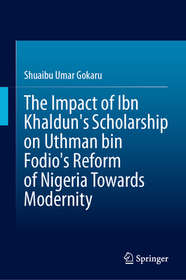
The Impact of Ibn Khaldun's Scholarship on Uthman bin Fodio's Reform of Nigeria Towards Modernity
-
GET 12% OFF
- Publisher's listprice EUR 106.99
-
41 790 Ft (39 800 Ft + 5% VAT)
The price is estimated because at the time of ordering we do not know what conversion rates will apply to HUF / product currency when the book arrives. In case HUF is weaker, the price increases slightly, in case HUF is stronger, the price goes lower slightly.
- Discount 12% (cc. 5 015 Ft off)
- Discounted price 36 775 Ft (35 024 Ft + 5% VAT)
36 775 Ft

Availability
Not yet published.
Why don't you give exact delivery time?
Delivery time is estimated on our previous experiences. We give estimations only, because we order from outside Hungary, and the delivery time mainly depends on how quickly the publisher supplies the book. Faster or slower deliveries both happen, but we do our best to supply as quickly as possible.
Product details:
- Publisher Springer Nature Switzerland
- Date of Publication 17 April 2026
- ISBN 9783032132437
- Binding Hardback
- No. of pages169 pages
- Size 235x155 mm
- Language English
- Illustrations XV, 169 p. 1 illus. 700
Categories
Long description:
This book explores the transformative role of Uthman bin Fodio in the reformation of Nigerian society, tracing his daʿwah (religious calling) from its earliest expressions to the establishment of the Sokoto Caliphate in the 19th century. While much has been written about his legacy, this study uniquely focuses on the initial motivations, methods, and communal strategies he employed, often overlooked in mainstream scholarship. Building upon the foundational theory of societal change (ʿumrān) by Ibn Khaldun, the work examines the intellectual and spiritual interplay between the Maghribi thinker and the West African reformer. It argues that Ibn Khaldun's cyclical theory of social development deeply informed Uthman bin Fodio’s vision, tactics, and success in transitioning society from a traditional to an Islamic governance model. Engaging both classical Islamic thought and historical sociology, this book fills a critical gap in understanding the ideological roots and methodological strategies behind one of the most significant Islamic reform movements in Sub-Saharan Africa. It will be a vital resource for students, historians, Islamic scholars, and anyone interested in the intersection of religion, society, and political change in Africa.
MoreTable of Contents:
Chapter 1. Introduction.- chapter 2. THE CONTRIBUTION OF UTHMAN BIN FODUYE ON SOCIETAL CHANGETHE CONTRIBUTION OF UTHMAN BIN FODUYE ON SOCIETAL CHANGE.- Chapter 3. IBN KHALDUN’S CONCEPT OF SOCIETY AND UMRAN.- Chapter 4. A DISCUSSION ON THE INFLUENCE OF IBN KHALDUN ON UTHMAN BIN FODUYE’S REFORMATION OF NIGERIAN FROM TRADITIONAL TO ISLAMIC SOCIETY.- Chapter 5. THE COMMON BACKGROUND BETWEEN UTHMAN BIN FODUYE AND IBN KHALDUN: A COMPARATIVE ANALYSIS OF THEIR THOUGHTS ON THE DECLINE OF STATES/SOCIETIES AND DYNASTIES.
More
