

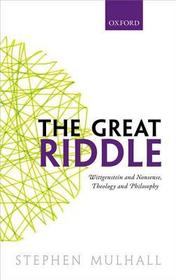
The Great Riddle
Wittgenstein and Nonsense, Theology and Philosophy
-
10% KEDVEZMÉNY?
- A kedvezmény csak az 'Értesítés a kedvenc témákról' hírlevelünk címzettjeinek rendeléseire érvényes.
- Kiadói listaár GBP 61.00
-
27 541 Ft (26 230 Ft + 5% áfa)
Az ár azért becsült, mert a rendelés pillanatában nem lehet pontosan tudni, hogy a beérkezéskor milyen lesz a forint árfolyama az adott termék eredeti devizájához képest. Ha a forint romlana, kissé többet, ha javulna, kissé kevesebbet kell majd fizetnie.
- Kedvezmény(ek) 10% (kb. 2 754 Ft)
- Kedvezményes ár 24 787 Ft (23 607 Ft + 5% áfa)
Iratkozzon fel most és részesüljön kedvezőbb árainkból!
Feliratkozom
27 541 Ft

Beszerezhetőség
Megrendelésre a kiadó utánnyomja a könyvet. Rendelhető, de a szokásosnál kicsit lassabban érkezik meg.
Why don't you give exact delivery time?
A beszerzés időigényét az eddigi tapasztalatokra alapozva adjuk meg. Azért becsült, mert a terméket külföldről hozzuk be, így a kiadó kiszolgálásának pillanatnyi gyorsaságától is függ. A megadottnál gyorsabb és lassabb szállítás is elképzelhető, de mindent megteszünk, hogy Ön a lehető leghamarabb jusson hozzá a termékhez.
A termék adatai:
- Kiadó OUP Oxford
- Megjelenés dátuma 2015. december 3.
- ISBN 9780198755326
- Kötéstípus Keménykötés
- Terjedelem148 oldal
- Méret 222x144x18 mm
- Súly 288 g
- Nyelv angol 0
Kategóriák
Rövid leírás:
Can we talk meaningfully about God? Grammatical Thomism affirms that religious language is nonsensical, because the reality of God is beyond our capacity for expression. 'Nonsense' is standardly taken to be a term of criticism in Wittgenstein's work, but Mulhall argues that we can exploit an analogy with riddles to take a more positive view.
TöbbHosszú leírás:
Can we talk meaningfully about God? The theological movement known as Grammatical Thomism affirms that religious language is nonsensical, because the reality of God is beyond our capacity for expression. Stephen Mulhall critically evaluates the claims of this movement (as exemplified in the work of Herbert McCabe and David Burrell) to be a legitimate inheritor of Wittgenstein's philosophical methods as well as Aquinas's theological project. The major obstacle to this claim is that Grammatical Thomism makes the nonsensicality of religious language when applied to God a touchstone of Thomist insight, whereas 'nonsense' is standardly taken to be solely a term of criticism in Wittgenstein's work. Mulhall argues that, if Wittgenstein is read in the terms provided by the work of Cora Diamond and Stanley Cavell, then a place can be found in both his early work and his later writings for a more positive role to be assigned to nonsensical utterances--one which depends on exploiting an analogy between religious language and riddles. And once this alignment between Wittgenstein and Aquinas is established, it also allows us to see various ways in which his later work has a perfectionist dimension--in that it overlaps with the concerns of moral perfectionism, and in that it attributes great philosophical significance to what theology and philosophy have traditionally called 'perfections' and 'transcendentals', particularly concepts such as Being, Truth, and Unity or Oneness. This results in a radical reconception of the role of analogous usage in language, and so in the relation between philosophy and theology.
Stephen Mulhall's recent book derived from his 2014 Stanton Lectures is a well written, carefully argued and sophisticated contribution which centrally rests upon a resolute reading of the early Wittgenstein. His project is to take the resolute reading combined with several other additional ways of reading Wittgenstein, such as Malcolm on analogy, to bring out hitherto unnoticed aspects of his work and offer a properly philosophically grounded articulation of grammatical Thomism. As the chapters progress there are steadily increasing layers of sophisticated Wittgenstein interpretation, such as that involving analogy, which build upon each other to claim that his later work has a perfectionist dimension which relates to the concerns of moral perfectionism and 'perfection' and 'transcendentals'.
Tartalomjegyzék:
Preface
Nonsense and Theology: Exhausting the Options?
The Flounder and the Fisherman's Wife: Tractarian Ethics, the Mystical, and the Religious
Grammatical Thomism: Five Ways of Refusing to Make Sense
Analogical Uses and the Projectiveness of Words: Wittgenstein's Vision of Language
Perfections and Transcendentals: Wittgenstein's Vision of Philosophy
Authority and Revelation: Philosophy and Theology
Epilogue

