

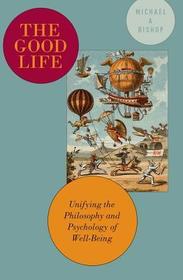
The Good Life
Unifying the Philosophy and Psychology of Well-Being
-
10% KEDVEZMÉNY?
- A kedvezmény csak az 'Értesítés a kedvenc témákról' hírlevelünk címzettjeinek rendeléseire érvényes.
- Kiadói listaár GBP 36.49
-
16 475 Ft (15 690 Ft + 5% áfa)
Az ár azért becsült, mert a rendelés pillanatában nem lehet pontosan tudni, hogy a beérkezéskor milyen lesz a forint árfolyama az adott termék eredeti devizájához képest. Ha a forint romlana, kissé többet, ha javulna, kissé kevesebbet kell majd fizetnie.
- Kedvezmény(ek) 10% (cc. 1 648 Ft off)
- Kedvezményes ár 14 827 Ft (14 121 Ft + 5% áfa)
Iratkozzon fel most és részesüljön kedvezőbb árainkból!
Feliratkozom
16 475 Ft

Beszerezhetőség
Megrendelésre a kiadó utánnyomja a könyvet. Rendelhető, de a szokásosnál kicsit lassabban érkezik meg.
Why don't you give exact delivery time?
A beszerzés időigényét az eddigi tapasztalatokra alapozva adjuk meg. Azért becsült, mert a terméket külföldről hozzuk be, így a kiadó kiszolgálásának pillanatnyi gyorsaságától is függ. A megadottnál gyorsabb és lassabb szállítás is elképzelhető, de mindent megteszünk, hogy Ön a lehető leghamarabb jusson hozzá a termékhez.
A termék adatai:
- Kiadó OUP USA
- Megjelenés dátuma 2015. február 26.
- ISBN 9780190603809
- Kötéstípus Puhakötés
- Terjedelem250 oldal
- Méret 206x137x15 mm
- Súly 299 g
- Nyelv angol 0
Kategóriák
Rövid leírás:
Science and philosophy study well-being with different but complementary methods. Marry these methods and a new picture emerges: To have well-being is to be "stuck" in a positive cycle of emotions, attitudes, traits and success. This book unites the scientific and philosophical worldviews into a powerful new theory of well-being.
TöbbHosszú leírás:
Philosophers defend theories of what well-being is but ignore what psychologists have learned about it, while psychologists learn about well-being but lack a theory of what it is. In The Good Life, Michael Bishop brings together these complementary investigations and proposes a powerful, new theory for understanding well-being.
The network theory holds that to have well-being is to be "stuck" in a self-perpetuating cycle of positive emotions, attitudes, traits and accomplishments. For someone with well-being, these states -- states such as joy and contentment, optimism and adventurousness, extraversion and perseverance, strong relationships, professional success and good health -- build upon and foster each other. They form a kind of positive causal network (PCN), so that a person high in well-being finds herself in a positive cycle or "groove." A person with a lesser degree of well-being might possess only fragments of such a network -- some positive feelings, attitudes, traits or successes, but not enough to kick start a full-blown, self-perpetuating network.
Although recent years have seen an explosion of psychological research into well-being, this discipline, often called Positive Psychology, has no consensus definition. The network theory provides a new framework for understanding Positive Psychology. When psychologists investigate correlations and causal connections among positive emotions, attitudes, traits, and accomplishments, they are studying the structure of PCNs. And when they identify states that establish, strengthen or extinguish PCNs, they are studying the dynamics of PCNs. Positive Psychology, then, is the study of the structure and dynamics of positive causal networks.
The Good Life represents a new, inclusive approach to the study of well-being, an approach committed to the proposition that discovering the nature of well-being requires the knowledge and skills of both the philosopher in her armchair and the scientist in her lab. The resulting theory provides a powerful, unified foundation for future scientific and philosophical investigations into well-being and the good life.
Michael Bishop's The Good Life: Unifying the Philosophy and Psychology of Well-Being hopefully represents a turning point in the study of well-being
Tartalomjegyzék:
Introduction
1. The Network Theory of Well-Being
2. An Inclusive Approach to the Study of Well-Being
3. Positive Causal Networks and the Network Theory of Well-Bein
4. Positive Causal Networks and Positive Psychology
5. The Case for the Network Theory: An Inference to the Best Explanation
6. Issues in the Psychology of Happiness and Well-Being
7. Objections to the Network Theory
8. Conclusion
References
Index

