

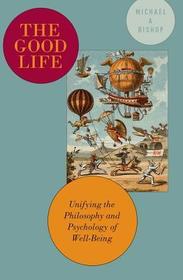
The Good Life
Unifying the Philosophy and Psychology of Well-Being
- Publisher's listprice GBP 36.49
-
16 475 Ft (15 690 Ft + 5% VAT)
The price is estimated because at the time of ordering we do not know what conversion rates will apply to HUF / product currency when the book arrives. In case HUF is weaker, the price increases slightly, in case HUF is stronger, the price goes lower slightly.
- Discount 10% (cc. 1 648 Ft off)
- Discounted price 14 827 Ft (14 121 Ft + 5% VAT)
Subcribe now and take benefit of a favourable price.
Subscribe
16 475 Ft

Availability
printed on demand
Why don't you give exact delivery time?
Delivery time is estimated on our previous experiences. We give estimations only, because we order from outside Hungary, and the delivery time mainly depends on how quickly the publisher supplies the book. Faster or slower deliveries both happen, but we do our best to supply as quickly as possible.
Product details:
- Publisher OUP USA
- Date of Publication 26 February 2015
- ISBN 9780190603809
- Binding Paperback
- No. of pages250 pages
- Size 206x137x15 mm
- Weight 299 g
- Language English 0
Categories
Short description:
Science and philosophy study well-being with different but complementary methods. Marry these methods and a new picture emerges: To have well-being is to be "stuck" in a positive cycle of emotions, attitudes, traits and success. This book unites the scientific and philosophical worldviews into a powerful new theory of well-being.
MoreLong description:
Philosophers defend theories of what well-being is but ignore what psychologists have learned about it, while psychologists learn about well-being but lack a theory of what it is. In The Good Life, Michael Bishop brings together these complementary investigations and proposes a powerful, new theory for understanding well-being.
The network theory holds that to have well-being is to be "stuck" in a self-perpetuating cycle of positive emotions, attitudes, traits and accomplishments. For someone with well-being, these states -- states such as joy and contentment, optimism and adventurousness, extraversion and perseverance, strong relationships, professional success and good health -- build upon and foster each other. They form a kind of positive causal network (PCN), so that a person high in well-being finds herself in a positive cycle or "groove." A person with a lesser degree of well-being might possess only fragments of such a network -- some positive feelings, attitudes, traits or successes, but not enough to kick start a full-blown, self-perpetuating network.
Although recent years have seen an explosion of psychological research into well-being, this discipline, often called Positive Psychology, has no consensus definition. The network theory provides a new framework for understanding Positive Psychology. When psychologists investigate correlations and causal connections among positive emotions, attitudes, traits, and accomplishments, they are studying the structure of PCNs. And when they identify states that establish, strengthen or extinguish PCNs, they are studying the dynamics of PCNs. Positive Psychology, then, is the study of the structure and dynamics of positive causal networks.
The Good Life represents a new, inclusive approach to the study of well-being, an approach committed to the proposition that discovering the nature of well-being requires the knowledge and skills of both the philosopher in her armchair and the scientist in her lab. The resulting theory provides a powerful, unified foundation for future scientific and philosophical investigations into well-being and the good life.
Michael Bishop's The Good Life: Unifying the Philosophy and Psychology of Well-Being hopefully represents a turning point in the study of well-being
Table of Contents:
Introduction
1. The Network Theory of Well-Being
2. An Inclusive Approach to the Study of Well-Being
3. Positive Causal Networks and the Network Theory of Well-Bein
4. Positive Causal Networks and Positive Psychology
5. The Case for the Network Theory: An Inference to the Best Explanation
6. Issues in the Psychology of Happiness and Well-Being
7. Objections to the Network Theory
8. Conclusion
References
Index

