

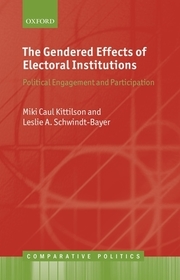
The Gendered Effects of Electoral Institutions
Political Engagement and Participation
Sorozatcím: Comparative Politics;
-
10% KEDVEZMÉNY?
- A kedvezmény csak az 'Értesítés a kedvenc témákról' hírlevelünk címzettjeinek rendeléseire érvényes.
- Kiadói listaár GBP 122.50
-
58 524 Ft (55 737 Ft + 5% áfa)
Az ár azért becsült, mert a rendelés pillanatában nem lehet pontosan tudni, hogy a beérkezéskor milyen lesz a forint árfolyama az adott termék eredeti devizájához képest. Ha a forint romlana, kissé többet, ha javulna, kissé kevesebbet kell majd fizetnie.
- Kedvezmény(ek) 10% (cc. 5 852 Ft off)
- Kedvezményes ár 52 671 Ft (50 163 Ft + 5% áfa)
Iratkozzon fel most és részesüljön kedvezőbb árainkból!
Feliratkozom
58 524 Ft

Beszerezhetőség
Megrendelésre a kiadó utánnyomja a könyvet. Rendelhető, de a szokásosnál kicsit lassabban érkezik meg.
Why don't you give exact delivery time?
A beszerzés időigényét az eddigi tapasztalatokra alapozva adjuk meg. Azért becsült, mert a terméket külföldről hozzuk be, így a kiadó kiszolgálásának pillanatnyi gyorsaságától is függ. A megadottnál gyorsabb és lassabb szállítás is elképzelhető, de mindent megteszünk, hogy Ön a lehető leghamarabb jusson hozzá a termékhez.
A termék adatai:
- Kiadó OUP Oxford
- Megjelenés dátuma 2012. október 18.
- ISBN 9780199608607
- Kötéstípus Keménykötés
- Terjedelem190 oldal
- Méret 241x162x17 mm
- Súly 446 g
- Nyelv angol 0
Kategóriák
Rövid leírás:
The Gendered Effects of Electoral Institutions argues that in most countries women continue to lag behind men in an array of political orientations and activities. Understanding this, and why some countries have been more successful than others in decreasing gender gaps, is imperative for producing stronger and more representative democracies.
TöbbHosszú leírás:
In most countries around the world, women continue to lag behind men in an array of political orientations and activities. Understanding why this is the case and why some countries have been more successful than others at moderating gender gaps in political involvement is imperative for producing stronger and more representative democracies. Cultural, socioeconomic, and political factors explain some of the gender gaps in political involvement, but not all of them. In this book, the authors argue that electoral institutions attenuate gender gaps in mass political engagement and participation by drawing women, an 'undertapped' constituency, into the democratic process. Using cross-national and country-specific analyses, the authors show that electoral institutions play a complementary and significant role in reducing gender gaps in political involvement. The cross-national analyses draw on comparative survey data from a wide range and large number of countries. The case studies draw out the processes underlying changes in political attitudes and behaviors with evidence from four country studies: New Zealand, Russia, France, and Uruguay. All four countries have altered their electoral institutions, either through large-scale reform of the electoral system itself or adopting gender quotas, allowing the authors to examine patterns of political involvement pre- and post-reform. The book finds that inclusive electoral systems that produce more proportional electoral outcomes have larger effects on women's political engagement and participation than on men's. Gender quotas also mediate women's engagement and participation, but to a lesser degree. On the whole, the book concludes that electoral rules designed to promote social inclusion in parliament are critical for promoting social group inclusion among the electorate.
Comparative Politics is a series for students, teachers, and researchers of political science that deals with contemporary government and politics. Global in scope, books in the series are characterised by a stress on comparative analysis and strong methodological rigour. The series is published in association with the European Consortium for Political Research. For more information visit: www.ecprnet.eu. The Comparative Politics Series is edited by Professor David M. Farrell, School of Politics and International Relations, University College Dublin, Kenneth Carty, Professor of Political Science, University of British Columbia, and Professor Dirk Berg-Schlosser, Institute of Political Science, Philipps University, Marburg.
Tartalomjegyzék:
Introduction: Gender Gaps on a Global Stage
A Theory of Electoral Institutions and Gender
Political Engagement, Institutions and the Gender Gap
Political Participation, Institutions and the Gender Gap
Electoral Reform and the Gender Gap in New Zealand and Russia
Gender Quotas and the Gender Gap in France and Uruguay
Conclusions: The Gendered Effects of Electoral Institutions
Appendix A: Sample Selection, Description of Variables and Modeling
Appendix B: Marginal Effects Tables for Interaction Terms in Chapters 3 and 4
Appendix C: Full Regression Models for Chapters 5
Appendix D: Regression Models for Chapter 6
References
Index

