

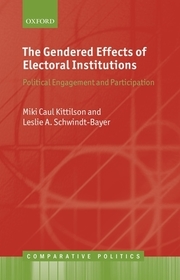
The Gendered Effects of Electoral Institutions
Political Engagement and Participation
Series: Comparative Politics;
- Publisher's listprice GBP 122.50
-
58 524 Ft (55 737 Ft + 5% VAT)
The price is estimated because at the time of ordering we do not know what conversion rates will apply to HUF / product currency when the book arrives. In case HUF is weaker, the price increases slightly, in case HUF is stronger, the price goes lower slightly.
- Discount 10% (cc. 5 852 Ft off)
- Discounted price 52 671 Ft (50 163 Ft + 5% VAT)
Subcribe now and take benefit of a favourable price.
Subscribe
58 524 Ft

Availability
printed on demand
Why don't you give exact delivery time?
Delivery time is estimated on our previous experiences. We give estimations only, because we order from outside Hungary, and the delivery time mainly depends on how quickly the publisher supplies the book. Faster or slower deliveries both happen, but we do our best to supply as quickly as possible.
Product details:
- Publisher OUP Oxford
- Date of Publication 18 October 2012
- ISBN 9780199608607
- Binding Hardback
- No. of pages190 pages
- Size 241x162x17 mm
- Weight 446 g
- Language English 0
Categories
Short description:
The Gendered Effects of Electoral Institutions argues that in most countries women continue to lag behind men in an array of political orientations and activities. Understanding this, and why some countries have been more successful than others in decreasing gender gaps, is imperative for producing stronger and more representative democracies.
MoreLong description:
In most countries around the world, women continue to lag behind men in an array of political orientations and activities. Understanding why this is the case and why some countries have been more successful than others at moderating gender gaps in political involvement is imperative for producing stronger and more representative democracies. Cultural, socioeconomic, and political factors explain some of the gender gaps in political involvement, but not all of them. In this book, the authors argue that electoral institutions attenuate gender gaps in mass political engagement and participation by drawing women, an 'undertapped' constituency, into the democratic process. Using cross-national and country-specific analyses, the authors show that electoral institutions play a complementary and significant role in reducing gender gaps in political involvement. The cross-national analyses draw on comparative survey data from a wide range and large number of countries. The case studies draw out the processes underlying changes in political attitudes and behaviors with evidence from four country studies: New Zealand, Russia, France, and Uruguay. All four countries have altered their electoral institutions, either through large-scale reform of the electoral system itself or adopting gender quotas, allowing the authors to examine patterns of political involvement pre- and post-reform. The book finds that inclusive electoral systems that produce more proportional electoral outcomes have larger effects on women's political engagement and participation than on men's. Gender quotas also mediate women's engagement and participation, but to a lesser degree. On the whole, the book concludes that electoral rules designed to promote social inclusion in parliament are critical for promoting social group inclusion among the electorate.
Comparative Politics is a series for students, teachers, and researchers of political science that deals with contemporary government and politics. Global in scope, books in the series are characterised by a stress on comparative analysis and strong methodological rigour. The series is published in association with the European Consortium for Political Research. For more information visit: www.ecprnet.eu. The Comparative Politics Series is edited by Professor David M. Farrell, School of Politics and International Relations, University College Dublin, Kenneth Carty, Professor of Political Science, University of British Columbia, and Professor Dirk Berg-Schlosser, Institute of Political Science, Philipps University, Marburg.
Table of Contents:
Introduction: Gender Gaps on a Global Stage
A Theory of Electoral Institutions and Gender
Political Engagement, Institutions and the Gender Gap
Political Participation, Institutions and the Gender Gap
Electoral Reform and the Gender Gap in New Zealand and Russia
Gender Quotas and the Gender Gap in France and Uruguay
Conclusions: The Gendered Effects of Electoral Institutions
Appendix A: Sample Selection, Description of Variables and Modeling
Appendix B: Marginal Effects Tables for Interaction Terms in Chapters 3 and 4
Appendix C: Full Regression Models for Chapters 5
Appendix D: Regression Models for Chapter 6
References
Index

