

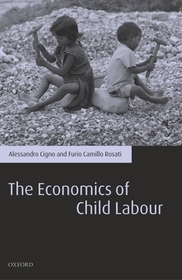
The Economics of Child Labour
-
10% KEDVEZMÉNY?
- A kedvezmény csak az 'Értesítés a kedvenc témákról' hírlevelünk címzettjeinek rendeléseire érvényes.
- Kiadói listaár GBP 147.50
-
66 596 Ft (63 425 Ft + 5% áfa)
Az ár azért becsült, mert a rendelés pillanatában nem lehet pontosan tudni, hogy a beérkezéskor milyen lesz a forint árfolyama az adott termék eredeti devizájához képest. Ha a forint romlana, kissé többet, ha javulna, kissé kevesebbet kell majd fizetnie.
- Kedvezmény(ek) 10% (cc. 6 660 Ft off)
- Kedvezményes ár 59 937 Ft (57 083 Ft + 5% áfa)
Iratkozzon fel most és részesüljön kedvezőbb árainkból!
Feliratkozom
66 596 Ft

Beszerezhetőség
Megrendelésre a kiadó utánnyomja a könyvet. Rendelhető, de a szokásosnál kicsit lassabban érkezik meg.
Why don't you give exact delivery time?
A beszerzés időigényét az eddigi tapasztalatokra alapozva adjuk meg. Azért becsült, mert a terméket külföldről hozzuk be, így a kiadó kiszolgálásának pillanatnyi gyorsaságától is függ. A megadottnál gyorsabb és lassabb szállítás is elképzelhető, de mindent megteszünk, hogy Ön a lehető leghamarabb jusson hozzá a termékhez.
A termék adatai:
- Kiadó OUP Oxford
- Megjelenés dátuma 2005. július 28.
- ISBN 9780199264452
- Kötéstípus Keménykötés
- Terjedelem264 oldal
- Méret 241x162x21 mm
- Súly 531 g
- Nyelv angol
- Illusztrációk numerous diagrams and tables 0
Kategóriák
Rövid leírás:
In this book Cigno and Rosati develop a theoretical framework within which to analyze decisions about child labour, drawing on empirical studies and making policy recommendations. They address such issues as parental decisions, gender, education, health, fertility and infant mortality, and children living alone; provide studies of child labour in India, Vietnam, and Morocco; and discuss policies on compulsion and prohibition, redistribution, education, health, and the labour market.
TöbbHosszú leírás:
Children throughout the world are engaged in a great number of activities classifiable as work. These range from relatively harmless, even laudable, activities like helping parents in their domestic chores, to morally and physically dangerous ones like soldiering and prostitution. If we leave out the former, we are left with what are generally called "economic" activities. Only a small minority, less than 4 percent of all working children, are estimated to be engaged in what ILO defines as the "unconditional" worst forms of child labour. The absolute number of children estimated to be engaged in the latter is, however, a stunning 8.4 million.
Should we only be concerned about the worst forms of child labour? Most forms of child labour other than the worst ones have valuable learning-by-doing elements. Furthermore, child labour produces current income. If the family is credit rationed, child labour relaxes the liquidity constraint and increases current consumption. There is thus a trade-off between present and future consumption. To the extent that current consumption has a positive effect on future health (hence, on the child's future earning capacity and, more generally, utility), this trade-off may be lower than one might think.
This book provides a blend of theory, empirical analysis and policy discussion. The first three chapters develop a fairly comprehensive theory of child labour, and related variables such as fertility, and infant mortality. Chapter 4, concerned with the effects of trade, contains both theory and cross-country empirical evidence. The remaining chapters are country studies, aimed at illustrating and testing different aspects of the theory in different geographical contexts. These chapters apply the latest developments in microeconometric methodology for dealing with endogeneity, unobserved heterogeneity, and the evaluation of public intervention.
The book is a welcome addition to the literature. It should be of interest to development economists in general, and not merely those with research interests in child labour.
Tartalomjegyzék:
Introduction
Prolegomena
Child Labour, Education and Saving
Fertility, Infant Mortality, and Gender
International Trade
Child Labour, Education, Nutrition and Fertility in Rural India
Child Labour Effects of Access to Basic Utilities: Evidence from Five Countries
Health Effects of Child Labour: Evidence from Guatemala and Rural Vietnam
Credit Markets and Child Labour: The Effects of Shocks, Credit Rationing, and Insurance
Further Evidence on Fertility, Education, and Child Labour
Conclusion

