

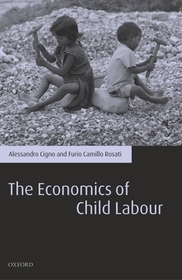
The Economics of Child Labour
- Publisher's listprice GBP 147.50
-
66 596 Ft (63 425 Ft + 5% VAT)
The price is estimated because at the time of ordering we do not know what conversion rates will apply to HUF / product currency when the book arrives. In case HUF is weaker, the price increases slightly, in case HUF is stronger, the price goes lower slightly.
- Discount 10% (cc. 6 660 Ft off)
- Discounted price 59 937 Ft (57 083 Ft + 5% VAT)
Subcribe now and take benefit of a favourable price.
Subscribe
66 596 Ft

Availability
printed on demand
Why don't you give exact delivery time?
Delivery time is estimated on our previous experiences. We give estimations only, because we order from outside Hungary, and the delivery time mainly depends on how quickly the publisher supplies the book. Faster or slower deliveries both happen, but we do our best to supply as quickly as possible.
Product details:
- Publisher OUP Oxford
- Date of Publication 28 July 2005
- ISBN 9780199264452
- Binding Hardback
- No. of pages264 pages
- Size 241x162x21 mm
- Weight 531 g
- Language English
- Illustrations numerous diagrams and tables 0
Categories
Short description:
In this book Cigno and Rosati develop a theoretical framework within which to analyze decisions about child labour, drawing on empirical studies and making policy recommendations. They address such issues as parental decisions, gender, education, health, fertility and infant mortality, and children living alone; provide studies of child labour in India, Vietnam, and Morocco; and discuss policies on compulsion and prohibition, redistribution, education, health, and the labour market.
MoreLong description:
Children throughout the world are engaged in a great number of activities classifiable as work. These range from relatively harmless, even laudable, activities like helping parents in their domestic chores, to morally and physically dangerous ones like soldiering and prostitution. If we leave out the former, we are left with what are generally called "economic" activities. Only a small minority, less than 4 percent of all working children, are estimated to be engaged in what ILO defines as the "unconditional" worst forms of child labour. The absolute number of children estimated to be engaged in the latter is, however, a stunning 8.4 million.
Should we only be concerned about the worst forms of child labour? Most forms of child labour other than the worst ones have valuable learning-by-doing elements. Furthermore, child labour produces current income. If the family is credit rationed, child labour relaxes the liquidity constraint and increases current consumption. There is thus a trade-off between present and future consumption. To the extent that current consumption has a positive effect on future health (hence, on the child's future earning capacity and, more generally, utility), this trade-off may be lower than one might think.
This book provides a blend of theory, empirical analysis and policy discussion. The first three chapters develop a fairly comprehensive theory of child labour, and related variables such as fertility, and infant mortality. Chapter 4, concerned with the effects of trade, contains both theory and cross-country empirical evidence. The remaining chapters are country studies, aimed at illustrating and testing different aspects of the theory in different geographical contexts. These chapters apply the latest developments in microeconometric methodology for dealing with endogeneity, unobserved heterogeneity, and the evaluation of public intervention.
The book is a welcome addition to the literature. It should be of interest to development economists in general, and not merely those with research interests in child labour.
Table of Contents:
Introduction
Prolegomena
Child Labour, Education and Saving
Fertility, Infant Mortality, and Gender
International Trade
Child Labour, Education, Nutrition and Fertility in Rural India
Child Labour Effects of Access to Basic Utilities: Evidence from Five Countries
Health Effects of Child Labour: Evidence from Guatemala and Rural Vietnam
Credit Markets and Child Labour: The Effects of Shocks, Credit Rationing, and Insurance
Further Evidence on Fertility, Education, and Child Labour
Conclusion

