

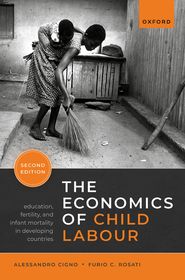
The Economics of Child Labour
Education, Fertility, and Infant Mortality in Developing Countries
-
10% KEDVEZMÉNY?
- A kedvezmény csak az 'Értesítés a kedvenc témákról' hírlevelünk címzettjeinek rendeléseire érvényes.
- Kiadói listaár GBP 30.00
-
13 545 Ft (12 900 Ft + 5% áfa)
Az ár azért becsült, mert a rendelés pillanatában nem lehet pontosan tudni, hogy a beérkezéskor milyen lesz a forint árfolyama az adott termék eredeti devizájához képest. Ha a forint romlana, kissé többet, ha javulna, kissé kevesebbet kell majd fizetnie.
- Kedvezmény(ek) 10% (cc. 1 355 Ft off)
- Kedvezményes ár 12 191 Ft (11 610 Ft + 5% áfa)
Iratkozzon fel most és részesüljön kedvezőbb árainkból!
Feliratkozom
13 545 Ft

Beszerezhetőség
Becsült beszerzési idő: A Prosperónál jelenleg nincsen raktáron, de a kiadónál igen. Beszerzés kb. 3-5 hét..
A Prosperónál jelenleg nincsen raktáron.
Why don't you give exact delivery time?
A beszerzés időigényét az eddigi tapasztalatokra alapozva adjuk meg. Azért becsült, mert a terméket külföldről hozzuk be, így a kiadó kiszolgálásának pillanatnyi gyorsaságától is függ. A megadottnál gyorsabb és lassabb szállítás is elképzelhető, de mindent megteszünk, hogy Ön a lehető leghamarabb jusson hozzá a termékhez.
A termék adatai:
- Kiadás sorszáma 2
- Kiadó OUP Oxford
- Megjelenés dátuma 2024. december 5.
- ISBN 9780198903000
- Kötéstípus Puhakötés
- Terjedelem304 oldal
- Méret 234x157x15 mm
- Súly 466 g
- Nyelv angol 560
Kategóriák
Rövid leírás:
Suitable as an advanced development economics or development microeconomics textbook, the book lays out the theory as it now stands and examines the available evidence within an integrated framework.
TöbbHosszú leírás:
Children throughout the world are engaged in a variety of activities classifiable as work. These range from relatively harmless, even laudable, activities like helping parents in the home, to morally or physically dangerous ones. Many forms of child labour have valuable learning-by-doing elements, but they all conflict with formal education. If the family is credit constrained, child labour relaxes the liquidity constraint and may be necessary to avoid starvation. Statistically and theoretically, child labour is associated with high fertility, high infant mortality, and low productivity. By contrast, education is associated with low fertility, low infant mortality, and high productivity. Suitable as an advanced development economics or development microeconomics textbook, the book lays out the theory as it now stands and examines the available evidence within an integrated framework.
This second edition emphasizes the interplay between child labour, education, fertility, and mortality.
The empirical aspects have been expanded to include new evidence available since the previous edition and an assessment of the impact of policy and programs. There are new chapters on the emergence and implications of family rules and social norms, and on policy optimization, and an expanded chapter on international trade examines the effects of foreign direct investment.
This book is a valuable resource for anyone seeking evidence-based insights into the causes and the consequences of child labor.
Tartalomjegyzék:
Introduction
Child Labour, Education, and Saving
Fertility, Infant Mortality, and Gender
Child Labour Effects of Credit Rationing and Uninsured Shocks: Evidence
Child Labour Effects of Access to Basic Utilities: Evidence
Estimates of the Demand for Child Labour
Health Effects of Child Labour: Evidence
Child Labour, Fertility, and Gender: Evidence
Social Norms and Family Rules
Internal Policy
Impact Evaluation of Child Labour Reduction Policies
International Trade and International Policies
Conclusion

