

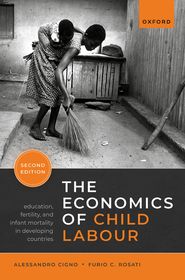
The Economics of Child Labour
Education, Fertility, and Infant Mortality in Developing Countries
- Publisher's listprice GBP 30.00
-
13 545 Ft (12 900 Ft + 5% VAT)
The price is estimated because at the time of ordering we do not know what conversion rates will apply to HUF / product currency when the book arrives. In case HUF is weaker, the price increases slightly, in case HUF is stronger, the price goes lower slightly.
- Discount 10% (cc. 1 355 Ft off)
- Discounted price 12 191 Ft (11 610 Ft + 5% VAT)
Subcribe now and take benefit of a favourable price.
Subscribe
13 545 Ft

Availability
Estimated delivery time: In stock at the publisher, but not at Prospero's office. Delivery time approx. 3-5 weeks.
Not in stock at Prospero.
Why don't you give exact delivery time?
Delivery time is estimated on our previous experiences. We give estimations only, because we order from outside Hungary, and the delivery time mainly depends on how quickly the publisher supplies the book. Faster or slower deliveries both happen, but we do our best to supply as quickly as possible.
Product details:
- Edition number 2
- Publisher OUP Oxford
- Date of Publication 5 December 2024
- ISBN 9780198903000
- Binding Paperback
- No. of pages304 pages
- Size 234x157x15 mm
- Weight 466 g
- Language English 560
Categories
Short description:
Suitable as an advanced development economics or development microeconomics textbook, the book lays out the theory as it now stands and examines the available evidence within an integrated framework.
MoreLong description:
Children throughout the world are engaged in a variety of activities classifiable as work. These range from relatively harmless, even laudable, activities like helping parents in the home, to morally or physically dangerous ones. Many forms of child labour have valuable learning-by-doing elements, but they all conflict with formal education. If the family is credit constrained, child labour relaxes the liquidity constraint and may be necessary to avoid starvation. Statistically and theoretically, child labour is associated with high fertility, high infant mortality, and low productivity. By contrast, education is associated with low fertility, low infant mortality, and high productivity. Suitable as an advanced development economics or development microeconomics textbook, the book lays out the theory as it now stands and examines the available evidence within an integrated framework.
This second edition emphasizes the interplay between child labour, education, fertility, and mortality.
The empirical aspects have been expanded to include new evidence available since the previous edition and an assessment of the impact of policy and programs. There are new chapters on the emergence and implications of family rules and social norms, and on policy optimization, and an expanded chapter on international trade examines the effects of foreign direct investment.
This book is a valuable resource for anyone seeking evidence-based insights into the causes and the consequences of child labor.
Table of Contents:
Introduction
Child Labour, Education, and Saving
Fertility, Infant Mortality, and Gender
Child Labour Effects of Credit Rationing and Uninsured Shocks: Evidence
Child Labour Effects of Access to Basic Utilities: Evidence
Estimates of the Demand for Child Labour
Health Effects of Child Labour: Evidence
Child Labour, Fertility, and Gender: Evidence
Social Norms and Family Rules
Internal Policy
Impact Evaluation of Child Labour Reduction Policies
International Trade and International Policies
Conclusion

