

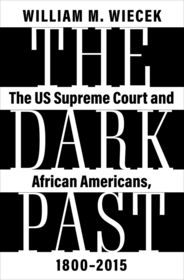
The Dark Past
The US Supreme Court and African Americans, 1800—2015
-
10% KEDVEZMÉNY?
- A kedvezmény csak az 'Értesítés a kedvenc témákról' hírlevelünk címzettjeinek rendeléseire érvényes.
- Kiadói listaár GBP 34.99
-
15 797 Ft (15 045 Ft + 5% áfa)
Az ár azért becsült, mert a rendelés pillanatában nem lehet pontosan tudni, hogy a beérkezéskor milyen lesz a forint árfolyama az adott termék eredeti devizájához képest. Ha a forint romlana, kissé többet, ha javulna, kissé kevesebbet kell majd fizetnie.
- Kedvezmény(ek) 10% (kb. 1 579 Ft)
- Kedvezményes ár 14 218 Ft (13 541 Ft + 5% áfa)
Iratkozzon fel most és részesüljön kedvezőbb árainkból!
Feliratkozom
15 797 Ft

Beszerezhetőség
Becsült beszerzési idő: A Prosperónál jelenleg nincsen raktáron, de a kiadónál igen. Beszerzés kb. 3-5 hét..
A Prosperónál jelenleg nincsen raktáron.
Why don't you give exact delivery time?
A beszerzés időigényét az eddigi tapasztalatokra alapozva adjuk meg. Azért becsült, mert a terméket külföldről hozzuk be, így a kiadó kiszolgálásának pillanatnyi gyorsaságától is függ. A megadottnál gyorsabb és lassabb szállítás is elképzelhető, de mindent megteszünk, hogy Ön a lehető leghamarabb jusson hozzá a termékhez.
A termék adatai:
- Kiadó OUP USA
- Megjelenés dátuma 2024. december 18.
- ISBN 9780197654439
- Kötéstípus Keménykötés
- Terjedelem552 oldal
- Méret 224x142x50 mm
- Súly 862 g
- Nyelv angol 547
Kategóriák
Rövid leírás:
The Dark Past offers a historical overview and interpretive guide to all the major cases decided by US Supreme Court that have affected the freedom and rights of Black Americans since 1800. It lends coherence to what could otherwise be a disjointed chronicle of cases and connects the events of the past to the current era of racial inequality.
TöbbHosszú leírás:
For most of its existence, the US Supreme Court has sustained slavery, racial discrimination, segregation, racial inequality, and white preference through constitutional interpretation and legal doctrine. During America's first two centuries, slavery was the law of the land. The Court initially avoided challenging it, and in 1857, it seemed that the justices were committed to defending it with the disastrous Dred Scott decision, which denied that Black Americans could claim any rights under the Constitution. The Court also failed to sustain Congress's effort to accord rights and status to Black Americans during Reconstruction, and it accepted white supremacy in the 1896 decision in Plessy v. Ferguson, which ratified the doctrine of "separate but equal." It did better in the Civil Rights Era, 1954-1972, but then again retreated in the face of political backlash.
The Dark Past offers a historical overview and interpretive guide to all the major cases decided by US Supreme Court that have affected the freedom and rights of Black Americans since 1800. It lends coherence to what could otherwise be a disjointed chronicle of cases and connects the events of the past to the current era of racial inequality-most recently exhibited in the Shelby County v. Holder (2015) decision, which hobbled the Voting Rights Act. Throughout the six hundred volumes of the United States Reports the justices have almost never alluded to the reality of racism or used words that denote it. Only once has the phrase "white supremacy" appeared in an opinion of the Court, and only thirty or so times has a member of the Court referred to "racism." The Dark Past, on the other hand, incorporates structural racism as a principal definition of inequality in the contemporary Black legal experience as it updates and enlarges our understanding of how the legal foundations of inequality structure American society.
We need this book. The Dark Past brilliantly exposes the US Supreme Court's historic role in sustaining slavery, segregation, racial discrimination and inequality, and white supremacy. It is depressing-and indispensable.
Tartalomjegyzék:
Prologue
Chapter 1: The Antebellum Court, 1800-1861
Chapter 2: Reconstruction and the Supreme Court, 1861-1880
Chapter 3: Redemption, 1880-1900
Chapter 4: The Nadir and the Blue Hour, 1900-1920
Chapter 5: Civil Rights and Civil Liberties Between the Wars, 1920-1940
Chapter 6: War and Cold War, 1941-1953
Chapter 7: The Second Reconstruction, 1954-1971
Chapter 8: Right Turn, 1960-1980
Chapter 9: The Resegregation of America's Schools
Chapter 10: Affirmative Action
Chapter 11: Redemption Redux, 1972-2015
Epilogue

