

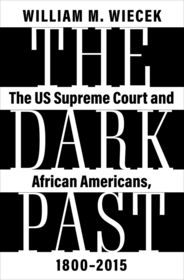
The Dark Past
The US Supreme Court and African Americans, 1800—2015
- Publisher's listprice GBP 34.99
-
15 797 Ft (15 045 Ft + 5% VAT)
The price is estimated because at the time of ordering we do not know what conversion rates will apply to HUF / product currency when the book arrives. In case HUF is weaker, the price increases slightly, in case HUF is stronger, the price goes lower slightly.
- Discount 10% (cc. 1 579 Ft off)
- Discounted price 14 218 Ft (13 541 Ft + 5% VAT)
Subcribe now and take benefit of a favourable price.
Subscribe
15 797 Ft

Availability
Estimated delivery time: In stock at the publisher, but not at Prospero's office. Delivery time approx. 3-5 weeks.
Not in stock at Prospero.
Why don't you give exact delivery time?
Delivery time is estimated on our previous experiences. We give estimations only, because we order from outside Hungary, and the delivery time mainly depends on how quickly the publisher supplies the book. Faster or slower deliveries both happen, but we do our best to supply as quickly as possible.
Product details:
- Publisher OUP USA
- Date of Publication 18 December 2024
- ISBN 9780197654439
- Binding Hardback
- No. of pages552 pages
- Size 224x142x50 mm
- Weight 862 g
- Language English 547
Categories
Short description:
The Dark Past offers a historical overview and interpretive guide to all the major cases decided by US Supreme Court that have affected the freedom and rights of Black Americans since 1800. It lends coherence to what could otherwise be a disjointed chronicle of cases and connects the events of the past to the current era of racial inequality.
MoreLong description:
For most of its existence, the US Supreme Court has sustained slavery, racial discrimination, segregation, racial inequality, and white preference through constitutional interpretation and legal doctrine. During America's first two centuries, slavery was the law of the land. The Court initially avoided challenging it, and in 1857, it seemed that the justices were committed to defending it with the disastrous Dred Scott decision, which denied that Black Americans could claim any rights under the Constitution. The Court also failed to sustain Congress's effort to accord rights and status to Black Americans during Reconstruction, and it accepted white supremacy in the 1896 decision in Plessy v. Ferguson, which ratified the doctrine of "separate but equal." It did better in the Civil Rights Era, 1954-1972, but then again retreated in the face of political backlash.
The Dark Past offers a historical overview and interpretive guide to all the major cases decided by US Supreme Court that have affected the freedom and rights of Black Americans since 1800. It lends coherence to what could otherwise be a disjointed chronicle of cases and connects the events of the past to the current era of racial inequality-most recently exhibited in the Shelby County v. Holder (2015) decision, which hobbled the Voting Rights Act. Throughout the six hundred volumes of the United States Reports the justices have almost never alluded to the reality of racism or used words that denote it. Only once has the phrase "white supremacy" appeared in an opinion of the Court, and only thirty or so times has a member of the Court referred to "racism." The Dark Past, on the other hand, incorporates structural racism as a principal definition of inequality in the contemporary Black legal experience as it updates and enlarges our understanding of how the legal foundations of inequality structure American society.
We need this book. The Dark Past brilliantly exposes the US Supreme Court's historic role in sustaining slavery, segregation, racial discrimination and inequality, and white supremacy. It is depressing-and indispensable.
Table of Contents:
Prologue
Chapter 1: The Antebellum Court, 1800-1861
Chapter 2: Reconstruction and the Supreme Court, 1861-1880
Chapter 3: Redemption, 1880-1900
Chapter 4: The Nadir and the Blue Hour, 1900-1920
Chapter 5: Civil Rights and Civil Liberties Between the Wars, 1920-1940
Chapter 6: War and Cold War, 1941-1953
Chapter 7: The Second Reconstruction, 1954-1971
Chapter 8: Right Turn, 1960-1980
Chapter 9: The Resegregation of America's Schools
Chapter 10: Affirmative Action
Chapter 11: Redemption Redux, 1972-2015
Epilogue

