

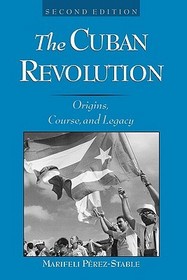
The Cuban Revolution
Origins, Course, and Legacy
-
10% KEDVEZMÉNY?
- A kedvezmény csak az 'Értesítés a kedvenc témákról' hírlevelünk címzettjeinek rendeléseire érvényes.
- Kiadói listaár GBP 26.00
-
11 739 Ft (11 180 Ft + 5% áfa)
Az ár azért becsült, mert a rendelés pillanatában nem lehet pontosan tudni, hogy a beérkezéskor milyen lesz a forint árfolyama az adott termék eredeti devizájához képest. Ha a forint romlana, kissé többet, ha javulna, kissé kevesebbet kell majd fizetnie.
- Kedvezmény(ek) 10% (cc. 1 174 Ft off)
- Kedvezményes ár 10 565 Ft (10 062 Ft + 5% áfa)
Iratkozzon fel most és részesüljön kedvezőbb árainkból!
Feliratkozom
11 739 Ft

Beszerezhetőség
A kiadónál véglegesen elfogyott, nem rendelhető. Érdemes újra keresni a címmel, hátha van újabb kiadás.
Why don't you give exact delivery time?
A beszerzés időigényét az eddigi tapasztalatokra alapozva adjuk meg. Azért becsült, mert a terméket külföldről hozzuk be, így a kiadó kiszolgálásának pillanatnyi gyorsaságától is függ. A megadottnál gyorsabb és lassabb szállítás is elképzelhető, de mindent megteszünk, hogy Ön a lehető leghamarabb jusson hozzá a termékhez.
A termék adatai:
- Kiadás sorszáma 2
- Kiadó OUP USA
- Megjelenés dátuma 1998. december 3.
- ISBN 9780195127492
- Kötéstípus Puhakötés
- Terjedelem288 oldal
- Méret 235x155x19 mm
- Súly 432 g
- Nyelv angol 0
Kategóriák
Rövid leírás:
This timely study provides a fresh re-examination of the achievements and failures of the Cuban revolution. It places the revolution firmly within the context of 20th century Cuban history, beginning with the inauguration of the republic in 1902 to Castro's triumphant entry into Santiago de Cuba in 1959, and highlights the factors which made Cuba susceptible to revolution. Identifying nationalism and the struggle for social justice as the legitimate forces behind the
revolution, Perez-Stable also provides insight into the problems facing Castro's Cuba, and argues that the revolution actually ended in 1970, doomed by a dependence on the Soviet Union and the failure of Cuba's leaders to implement appropriate economic, developmental, or democratic
policies.
Hosszú leírás:
This timely study provides a re-examination of the achievements and failures of the Cuban revolution. The Cuban Revolution places the revolution firmly within the context of twentieth century Cuban history, beginning with the inauguration of the republic in 1902 to Castro's triumphant entry into Santiago de Cuba in 1959, and hightlights the factors — such as a one-crop (sugar) economy and U.S. intereference in Cuban affairs — which made Cuba susceptible to
revolution. While identifying nationalism and the struggle for social justice as the legitimate forces behind the revolution, Perez-Stable also provides a fresh insight into the problems facing Castro's Cuba. Arguing that the revolution actually ended in 1970, she blames its defeat on the regime's profitable
yet doomed dependence on the Soviet Union and on the failure of Cuba's leaders to diversity the country's economy, sustain development, or create democratic institutions. The Cuban Revolution also focuses special attention on Cuba's confrontation with the United States.
This second edition has been updated to include an entirely new chapter with coverage of the changes affecting Cuba's policies and economy since the disintegration of the Soviet Union and the failure of communism in general, as well as a new preface, an up-to-date bibliography, and a thoroughly revised concluding chapter summing up the prospects and possibilities of Cuba's future in the twenty-first century.
Tartalomjegyzék:
Preface
Preface to the First Edition
Contents
List of Tables
List of Acronmyms
Introduction
Meidated Sovereignty, Monoculture, and Development
Politics and Society, 1902-1958
Revolution and Radical Nationalism, 1959-1961
Revolution and Inclusive Development
Politics and Society, 1961-1970
Politics and Society, 1971-1986
Revolution, Rectification, and Contemporary Socialism
The Invisible Crisis: Stability and Change in 1990s Cuba
Conclusion
Bibliography
Index

