

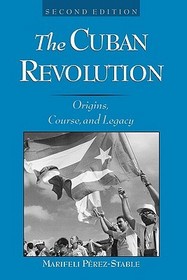
The Cuban Revolution
Origins, Course, and Legacy
- Publisher's listprice GBP 26.00
-
11 739 Ft (11 180 Ft + 5% VAT)
The price is estimated because at the time of ordering we do not know what conversion rates will apply to HUF / product currency when the book arrives. In case HUF is weaker, the price increases slightly, in case HUF is stronger, the price goes lower slightly.
- Discount 10% (cc. 1 174 Ft off)
- Discounted price 10 565 Ft (10 062 Ft + 5% VAT)
Subcribe now and take benefit of a favourable price.
Subscribe
11 739 Ft

Availability
Out of print
Why don't you give exact delivery time?
Delivery time is estimated on our previous experiences. We give estimations only, because we order from outside Hungary, and the delivery time mainly depends on how quickly the publisher supplies the book. Faster or slower deliveries both happen, but we do our best to supply as quickly as possible.
Product details:
- Edition number 2
- Publisher OUP USA
- Date of Publication 3 December 1998
- ISBN 9780195127492
- Binding Paperback
- No. of pages288 pages
- Size 235x155x19 mm
- Weight 432 g
- Language English 0
Categories
Short description:
This timely study provides a fresh re-examination of the achievements and failures of the Cuban revolution. It places the revolution firmly within the context of 20th century Cuban history, beginning with the inauguration of the republic in 1902 to Castro's triumphant entry into Santiago de Cuba in 1959, and highlights the factors which made Cuba susceptible to revolution. Identifying nationalism and the struggle for social justice as the legitimate forces behind the
revolution, Perez-Stable also provides insight into the problems facing Castro's Cuba, and argues that the revolution actually ended in 1970, doomed by a dependence on the Soviet Union and the failure of Cuba's leaders to implement appropriate economic, developmental, or democratic
policies.
Long description:
This timely study provides a re-examination of the achievements and failures of the Cuban revolution. The Cuban Revolution places the revolution firmly within the context of twentieth century Cuban history, beginning with the inauguration of the republic in 1902 to Castro's triumphant entry into Santiago de Cuba in 1959, and hightlights the factors — such as a one-crop (sugar) economy and U.S. intereference in Cuban affairs — which made Cuba susceptible to
revolution. While identifying nationalism and the struggle for social justice as the legitimate forces behind the revolution, Perez-Stable also provides a fresh insight into the problems facing Castro's Cuba. Arguing that the revolution actually ended in 1970, she blames its defeat on the regime's profitable
yet doomed dependence on the Soviet Union and on the failure of Cuba's leaders to diversity the country's economy, sustain development, or create democratic institutions. The Cuban Revolution also focuses special attention on Cuba's confrontation with the United States.
This second edition has been updated to include an entirely new chapter with coverage of the changes affecting Cuba's policies and economy since the disintegration of the Soviet Union and the failure of communism in general, as well as a new preface, an up-to-date bibliography, and a thoroughly revised concluding chapter summing up the prospects and possibilities of Cuba's future in the twenty-first century.
Table of Contents:
Preface
Preface to the First Edition
Contents
List of Tables
List of Acronmyms
Introduction
Meidated Sovereignty, Monoculture, and Development
Politics and Society, 1902-1958
Revolution and Radical Nationalism, 1959-1961
Revolution and Inclusive Development
Politics and Society, 1961-1970
Politics and Society, 1971-1986
Revolution, Rectification, and Contemporary Socialism
The Invisible Crisis: Stability and Change in 1990s Cuba
Conclusion
Bibliography
Index

