

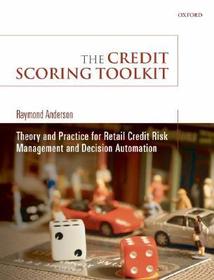
The Credit Scoring Toolkit
Theory and Practice for Retail Credit Risk Management and Decision Automation
-
10% KEDVEZMÉNY?
- A kedvezmény csak az 'Értesítés a kedvenc témákról' hírlevelünk címzettjeinek rendeléseire érvényes.
- Kiadói listaár GBP 170.00
-
76 755 Ft (73 100 Ft + 5% áfa)
Az ár azért becsült, mert a rendelés pillanatában nem lehet pontosan tudni, hogy a beérkezéskor milyen lesz a forint árfolyama az adott termék eredeti devizájához képest. Ha a forint romlana, kissé többet, ha javulna, kissé kevesebbet kell majd fizetnie.
- Kedvezmény(ek) 10% (cc. 7 676 Ft off)
- Kedvezményes ár 69 080 Ft (65 790 Ft + 5% áfa)
Iratkozzon fel most és részesüljön kedvezőbb árainkból!
Feliratkozom
76 755 Ft

Beszerezhetőség
Megrendelésre a kiadó utánnyomja a könyvet. Rendelhető, de a szokásosnál kicsit lassabban érkezik meg.
Why don't you give exact delivery time?
A beszerzés időigényét az eddigi tapasztalatokra alapozva adjuk meg. Azért becsült, mert a terméket külföldről hozzuk be, így a kiadó kiszolgálásának pillanatnyi gyorsaságától is függ. A megadottnál gyorsabb és lassabb szállítás is elképzelhető, de mindent megteszünk, hogy Ön a lehető leghamarabb jusson hozzá a termékhez.
A termék adatai:
- Kiadó OUP Oxford
- Megjelenés dátuma 2007. augusztus 30.
- ISBN 9780199226405
- Kötéstípus Keménykötés
- Terjedelem790 oldal
- Méret 254x196x51 mm
- Súly 1674 g
- Nyelv angol
- Illusztrációk Numerous halftone figures 0
Kategóriák
Rövid leírás:
An up-to-date, comprehensive overview of credit scoring, covering the scorecard development process, all aspects of its use and how it affects businesses and consumers, from micro-lending through to large unlisted companies.
TöbbHosszú leírás:
The Credit Scoring Toolkit provides an all-encompassing view of the use of statistical models to assess retail credit risk and provide automated decisions.
In eight modules, the book provides frameworks for both theory and practice. It first explores the economic justification and history of Credit Scoring, risk linkages and decision science, statistical and mathematical tools, the assessment of business enterprises, and regulatory issues ranging from data privacy to Basel II. It then provides a practical how-to-guide for scorecard development, including data collection, scorecard implementation, and use within the credit risk management cycle.
Including numerous real-life examples and an extensive glossary and bibliography, the text assumes little prior knowledge making it an indispensable desktop reference for graduate students in statistics, business, economics and finance, MBA students, credit risk and financial practitioners.
This is an extremely valuable and timely book on a very important topic ... Anderson has provided a great service to all who use Credit Scoring techniques.
Tartalomjegyzék:
Preface
A Setting the scene
Credit scoring and the business
Credit micro-histories
The mechanics of credit scoring
B Risky business
The theory of risk
Decision science
Assessing enterprise risk
C Stats and Maths
Predictive statistics 101
Measures of separation/divergence
Odds and ends
D Data!
Data considerations and design
Data sources
Scoring structure
Information sharing
Data preparation
E Scorecard development
Transformation
Characteristic selection
Segmentation
Reject inference
Scorecard calibration
Validation
Development management issues
F Implementation and use
Implementation
Overrides, referrals, and controls
Monitoring
Finance
G Risk management cycle
Marketing
Application processing
Account management
Collection and recoveries
Fraud
H Regulatory environment
Regulatory concepts
Data privacy and protection
Anti-discrimination
Fair lending
Capital adequacy
Know your customer (KYC)
National differences
Z Reference materials
Glossary / Dictionary
Bibliography
Appendices
Index

