

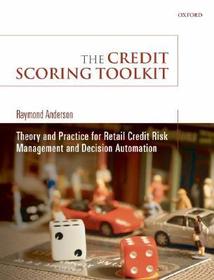
The Credit Scoring Toolkit
Theory and Practice for Retail Credit Risk Management and Decision Automation
- Publisher's listprice GBP 170.00
-
76 755 Ft (73 100 Ft + 5% VAT)
The price is estimated because at the time of ordering we do not know what conversion rates will apply to HUF / product currency when the book arrives. In case HUF is weaker, the price increases slightly, in case HUF is stronger, the price goes lower slightly.
- Discount 10% (cc. 7 676 Ft off)
- Discounted price 69 080 Ft (65 790 Ft + 5% VAT)
Subcribe now and take benefit of a favourable price.
Subscribe
76 755 Ft

Availability
printed on demand
Why don't you give exact delivery time?
Delivery time is estimated on our previous experiences. We give estimations only, because we order from outside Hungary, and the delivery time mainly depends on how quickly the publisher supplies the book. Faster or slower deliveries both happen, but we do our best to supply as quickly as possible.
Product details:
- Publisher OUP Oxford
- Date of Publication 30 August 2007
- ISBN 9780199226405
- Binding Hardback
- No. of pages790 pages
- Size 254x196x51 mm
- Weight 1674 g
- Language English
- Illustrations Numerous halftone figures 0
Categories
Short description:
An up-to-date, comprehensive overview of credit scoring, covering the scorecard development process, all aspects of its use and how it affects businesses and consumers, from micro-lending through to large unlisted companies.
MoreLong description:
The Credit Scoring Toolkit provides an all-encompassing view of the use of statistical models to assess retail credit risk and provide automated decisions.
In eight modules, the book provides frameworks for both theory and practice. It first explores the economic justification and history of Credit Scoring, risk linkages and decision science, statistical and mathematical tools, the assessment of business enterprises, and regulatory issues ranging from data privacy to Basel II. It then provides a practical how-to-guide for scorecard development, including data collection, scorecard implementation, and use within the credit risk management cycle.
Including numerous real-life examples and an extensive glossary and bibliography, the text assumes little prior knowledge making it an indispensable desktop reference for graduate students in statistics, business, economics and finance, MBA students, credit risk and financial practitioners.
This is an extremely valuable and timely book on a very important topic ... Anderson has provided a great service to all who use Credit Scoring techniques.
Table of Contents:
Preface
A Setting the scene
Credit scoring and the business
Credit micro-histories
The mechanics of credit scoring
B Risky business
The theory of risk
Decision science
Assessing enterprise risk
C Stats and Maths
Predictive statistics 101
Measures of separation/divergence
Odds and ends
D Data!
Data considerations and design
Data sources
Scoring structure
Information sharing
Data preparation
E Scorecard development
Transformation
Characteristic selection
Segmentation
Reject inference
Scorecard calibration
Validation
Development management issues
F Implementation and use
Implementation
Overrides, referrals, and controls
Monitoring
Finance
G Risk management cycle
Marketing
Application processing
Account management
Collection and recoveries
Fraud
H Regulatory environment
Regulatory concepts
Data privacy and protection
Anti-discrimination
Fair lending
Capital adequacy
Know your customer (KYC)
National differences
Z Reference materials
Glossary / Dictionary
Bibliography
Appendices
Index

