

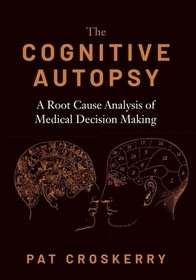
The Cognitive Autopsy
A Root Cause Analysis of Medical Decision Making
-
10% KEDVEZMÉNY?
- A kedvezmény csak az 'Értesítés a kedvenc témákról' hírlevelünk címzettjeinek rendeléseire érvényes.
- Kiadói listaár GBP 58.00
-
26 187 Ft (24 940 Ft + 5% áfa)
Az ár azért becsült, mert a rendelés pillanatában nem lehet pontosan tudni, hogy a beérkezéskor milyen lesz a forint árfolyama az adott termék eredeti devizájához képest. Ha a forint romlana, kissé többet, ha javulna, kissé kevesebbet kell majd fizetnie.
- Kedvezmény(ek) 10% (kb. 2 619 Ft)
- Kedvezményes ár 23 568 Ft (22 446 Ft + 5% áfa)
Iratkozzon fel most és részesüljön kedvezőbb árainkból!
Feliratkozom
26 187 Ft

Beszerezhetőség
Megrendelésre a kiadó utánnyomja a könyvet. Rendelhető, de a szokásosnál kicsit lassabban érkezik meg.
Why don't you give exact delivery time?
A beszerzés időigényét az eddigi tapasztalatokra alapozva adjuk meg. Azért becsült, mert a terméket külföldről hozzuk be, így a kiadó kiszolgálásának pillanatnyi gyorsaságától is függ. A megadottnál gyorsabb és lassabb szállítás is elképzelhető, de mindent megteszünk, hogy Ön a lehető leghamarabb jusson hozzá a termékhez.
A termék adatai:
- Kiadó OUP USA
- Megjelenés dátuma 2020. július 24.
- ISBN 9780190088743
- Kötéstípus Puhakötés
- Terjedelem344 oldal
- Méret 251x175x17 mm
- Súly 703 g
- Nyelv angol 6
Kategóriák
Rövid leírás:
Recently, it has become clear that medical error is a leading cause of death, and one of the biggest problems occurs when doctors get the diagnosis wrong. Typically, patients may feel that their diagnosis was delayed or wrong because the doctor didn't know enough about their disease, but many studies now show that the problem is more likely to be a failure in how doctors think rather than in what they don't know. This book offers some insight into how doctors think. It identifies a number of biases in medical decision making that are largely responsible for diagnoses being delayed or missed.
TöbbHosszú leírás:
Behind heart disease and cancer, medical error is now listed as one of the leading causes of death. Of the many medical errors that may lead to injury and death, diagnostic failure is regarded as the most significant. Generally, the majority of diagnostic failures are attributed to the clinicians directly involved with the patient, and to a lesser extent, the system in which they work. In turn, the majority of errors made by clinicians are due to decision making failures manifested by various departures from rationality. Of all the medical environments in which patients are seen and diagnosed, the emergency department is the most challenging. It has been described as a "wicked" environment where illness and disease may range from minor ailments and complaints to severe, life-threatening disorders.
The Cognitive Autopsy is a novel strategy towards understanding medical error and diagnostic failure in 42 clinical cases with which the author was directly involved or became aware of at the time. Essentially, it describes a cognitive approach towards root cause analysis of medical adverse events or near misses. Whereas root cause analysis typically focuses on the observable and measurable aspects of adverse events, the cognitive autopsy attempts to identify covert cognitive processes that may have contributed to outcomes. In this clinical setting, no cognitive process is directly observable but must be inferred from the behavior of the individual clinician. The book illustrates unequivocally that chief among these cognitive processes are cognitive biases and other flaws in decision making, rather than knowledge deficits.
This is the first book I have read that uses actual patient care cases to investigate medical decisions that lead to errors and eventually unexpected outcomes. The depth of the discussion in these cases leaves readers with a good understanding of the processes that lead to the outcomes.
Tartalomjegyzék:
Foreword
Preface
Acknowledgements
Introduction
The Cases
Case 1. Christmas Surprises
Case 2. Distraught Distraction
Case 3. The Fortunate Footballer
Case 4. An Incommoded Interior Designer
Case 5. Teenage Tachypnoea
Case 6. The Backed-up Bed Blocker
Case 7. The English Patient
Case 8. Lazarus Redux
Case 9. A Model Pilot
Case 10. A Rash Diagnosis
Case 11. The Perfect Storm
Case 12. A Case of Premature Closure
Case 13. Postpartum Puzzler
Case 14. The Blind Leading the Blindable
Case 15. Pseudodiagnosis of Pseudoseizure
Case 16. Failed Frequent Flyers (a and b)
Case 17. Explosions, Expletives and Erroneous Explanations
Case 18. The Representativeness Representative
Case 19. The Michelin Lady
Case 20. An Instable Inadvertence
Case 21. A Laconic Lad
Case 22. The Misunderstood Matelot
Case 23. A Hard Tale to Swallow
Case 24. A Rake's Progress
Case 25. Deceptive Detachment
Case 26. A Search Satisfied Skateboarder
Case 27. The Vacillated Vagrant
Case 28. A Tale of Two Cycles (a and b)
Case 29. Misleading Mydriasis
Case 30. Bungled Bullae
Case 31. Overdosing the Overdosed
Case 32. The Lost Guide
Case 33. Hazardous Handover
Case 34. Double Trouble
Case 35. Tracking Fast and Slow
Case 36. Alternate Alternatives
Case 37. Notable Near-miss
Case 38. A Stone Left Unturned
Case 39. Sweet Nothings
Case 40. Straining the Strain Diagnosis
Case 41. Missed It
Conclusion: Strategies for Improving Clinical Decision Making
Appendix A: Diagnoses in 42 Cases
Appendix B: Probable Biases and Their Frequencies in 42 Clinical Cases
Appendix C: Analysis of Ordinal Position of Bias in Clinical Cases
Appendix D: Potential Error-Producing Conditions
Appendix E: Analysis of Knowledge-Based Errors in the Case Series
Glossary of Biases and Their Cognitive Factors
Index

