

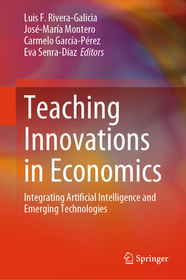
Teaching Innovations in Economics
Integrating Artificial Intelligence and Emerging Technologies
-
12% KEDVEZMÉNY?
- Kiadói listaár EUR 181.89
-
75 438 Ft (71 846 Ft + 5% áfa)
Az ár azért becsült, mert a rendelés pillanatában nem lehet pontosan tudni, hogy a beérkezéskor milyen lesz a forint árfolyama az adott termék eredeti devizájához képest. Ha a forint romlana, kissé többet, ha javulna, kissé kevesebbet kell majd fizetnie.
- Kedvezmény(ek) 12% (cc. 9 053 Ft off)
- Kedvezményes ár 66 386 Ft (63 224 Ft + 5% áfa)
66 386 Ft

Beszerezhetőség
Megrendelésre a kiadó utánnyomja a könyvet. Rendelhető, de a szokásosnál kicsit lassabban érkezik meg.
Why don't you give exact delivery time?
A beszerzés időigényét az eddigi tapasztalatokra alapozva adjuk meg. Azért becsült, mert a terméket külföldről hozzuk be, így a kiadó kiszolgálásának pillanatnyi gyorsaságától is függ. A megadottnál gyorsabb és lassabb szállítás is elképzelhető, de mindent megteszünk, hogy Ön a lehető leghamarabb jusson hozzá a termékhez.
A termék adatai:
- Kiadó Springer Nature Switzerland
- Megjelenés dátuma 2026. január 3.
- ISBN 9783032082121
- Kötéstípus Keménykötés
- Terjedelem468 oldal
- Méret 235x155 mm
- Nyelv angol
- Illusztrációk XXII, 468 p. 124 illus., 79 illus. in color. 684
Kategóriák
Hosszú leírás:
This book offers educators a comprehensive, practical guide to modernizing their teaching methods, enabling economic theory to connect directly with the demands of the digital world. The landscape of economics education is undergoing an unprecedented transformation, driven by the integration of advanced technologies, especially artificial intelligence (AI) and other emerging digital tools. Through real-world case studies and innovative methodological frameworks, this book presents concrete strategies to:
- Implement AI solutions and emerging technologies in the classroom.
- Design personalized learning experiences tailored to each student’s unique needs.
- Utilize virtual tutoring and automated assessments to foster a deeper understanding of economic concepts.
- Adapt and transform traditional pedagogical practices into dynamic, student-centered models.
Written by a team of internationally renowned experts, this book is an indispensable resource for university professors, researchers, and education professionals. By exploring new frontiers in teaching, the book not only enriches pedagogical practice but also equips students to successfully navigate the challenges of the digital age economy.
TöbbTartalomjegyzék:
Part 1: Theoretical frameworks and critical reflections on AI and teaching.- A critical framework for pedagogical evaluation in generative environments: Integrating heuristic serendipity and assisted materiality in higher education.- Reinventing the human in the age of AI.- From enigma to a generative AI teaching-learning paradigm.- Part 2: Artificial intelligence as a cross-cutting tool in economics education.- Artificial intelligence applied to teaching and research in welfare economics, inequality, and poverty.- Using artificial intelligence (AI) in the teaching of economics and business at university level: Resources and examples.- Integrating AI and data analysis strategies in macroeconomics pedagogy: The case of the Phillips curve.- Personalized learning paths in microeconomics.- Teaching innovation in the teaching of economic history in the bachelor's degree in tourism.- Part 3: Technological innovations and AI applications in the classroom.- Personalizing the teaching of programming and social statistics through AI.- Python tools for teaching econometrics through interactive learning.- Integrating AI and visual tools in economics education: Enhancing pedagogy through mermaid and large language models.- Code generation through generative artificial intelligence: Solving various relevant mathematical and applied economics problems.- Part 4: Active learning, simulations, and hybrid environments.- Enhancing strategic thinking, resilience and conflict resolution skills through artificial-intelligence driven simulations.- Market simulations and custom GPTS as tools for active learning in “Introduction to Economics”.- Designing effective hybrid learning environments in higher education: A case study of successful implementation and evaluation.- When AI takes a seat at the desk: Innovating business education.- Part 5: Institutional, social, and motivational perspectives.- Data, educational technology, and teaching innovation: Establishing an observatory to enhance student motivation and academic performance in business administration.- Perception of student engagement in higher education: A comparative analysis.- Innovative teaching in business intelligence: Adapting to advanced tools and market demands.- Humor, corporate diplomacy and SCM in the classroom.- Artificial intelligence applied to mathematics in economics.
Több
