

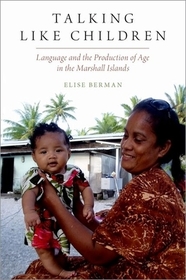
Talking Like Children
Language and the Production of Age in the Marshall Islands
Sorozatcím: Oxf Studies in Anthropology of Language;
-
10% KEDVEZMÉNY?
- A kedvezmény csak az 'Értesítés a kedvenc témákról' hírlevelünk címzettjeinek rendeléseire érvényes.
- Kiadói listaár GBP 102.50
-
46 278 Ft (44 075 Ft + 5% áfa)
Az ár azért becsült, mert a rendelés pillanatában nem lehet pontosan tudni, hogy a beérkezéskor milyen lesz a forint árfolyama az adott termék eredeti devizájához képest. Ha a forint romlana, kissé többet, ha javulna, kissé kevesebbet kell majd fizetnie.
- Kedvezmény(ek) 10% (kb. 4 627 Ft)
- Kedvezményes ár 41 651 Ft (39 668 Ft + 5% áfa)
Iratkozzon fel most és részesüljön kedvezőbb árainkból!
Feliratkozom
46 278 Ft

Beszerezhetőség
Megrendelésre a kiadó utánnyomja a könyvet. Rendelhető, de a szokásosnál kicsit lassabban érkezik meg.
Why don't you give exact delivery time?
A beszerzés időigényét az eddigi tapasztalatokra alapozva adjuk meg. Azért becsült, mert a terméket külföldről hozzuk be, így a kiadó kiszolgálásának pillanatnyi gyorsaságától is függ. A megadottnál gyorsabb és lassabb szállítás is elképzelhető, de mindent megteszünk, hogy Ön a lehető leghamarabb jusson hozzá a termékhez.
A termék adatai:
- Kiadó OUP USA
- Megjelenés dátuma 2019. május 30.
- ISBN 9780190876975
- Kötéstípus Keménykötés
- Terjedelem224 oldal
- Méret 160x239x15 mm
- Súly 516 g
- Nyelv angol
- Illusztrációk 26 illus. 0
Kategóriák
Rövid leírás:
Talking Like Children is a series of captivating stories that show how age comes to be. Elise Berman analyzes adoption negotiations, efforts to keep food, and debates about supposed child abuse. In these situations, age differences emerge through the decisions people make, the emotions they feel, and the power they gain.
TöbbHosszú leírás:
Children in the Marshall Islands do many things that adults do not. They walk around half naked. They carry and eat food in public without offering it to others. They talk about things they see rather than hiding uncomfortable truths. They explicitly refuse to give. Why do they do these things?
Many think these behaviors are a natural result of children's innate immaturity. But Elise Berman argues that children are actually taught to do things that adults avoid: to be rude, inappropriate, and immature. Before children learn to be adults, they learn to be different from them. Berman's main theoretical claim therefore is also a novel one: age emerges through interaction and is a social production.
In Talking Like Children, Berman analyzes a variety of interactions in the Marshall Islands, all broadly based around exchange: adoption negotiations, efforts to ask for or avoid giving away food, contentious debates about supposed child abuse. In these dramas both large and small, age differences emerge through the decisions people make, the emotions they feel, and the power they gain. Berman's research includes a range of methods -- participant observation, video and audio recordings, interviews, children's drawings -- that yield a significant corpus of data including over 80 hours of recorded naturalistic social interaction.
Presented as a series of captivating stories, Talking Like Children is an intimate analysis of speech and interaction that shows what age means. Like gender and race, age differences are both culturally produced and socially important. The differences between Marshallese children and adults give both groups the ability to manipulate social life in distinct but often complementary ways. These differences produce culture itself. Talking Like Children establishes age as a foundational social variable and a central concern of anthropological and linguistic research.
This excellent monograph engages critically with the theoretical literature on language socialization and the study of age through ethnographic exploration of village life in the Marshall Islands. Berman uses precise ethnolinguistic data to make her conceptual points and narrative threads to create coherence within and between chapters.
Tartalomjegyzék:
Acknowledgements
List of Figures and Tables
Note on Marshallese Language and Orthography
Introduction: Becoming different
Chapter 1: "Give Me My Child": An ethnographic introduction to the power of age in Marshallese social life
Chapter 2: What is Age and Where Does It Come From? A theoretical analysis of age and language socialization
Chapter 3: On the Road: How to get out of giving to adults
Chapter 4: "Give Me My Food": How to avoid giving to another child and produce relative age
Chapter 5: Aged Agency: What children can do that adults cannot (and vice versa)
Chapter 6: Socializing Age Differences
Conclusion: Toward an Anthropology of Age
Appendix: Transcripts
Notes
References
Index

