

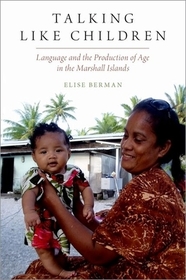
Talking Like Children
Language and the Production of Age in the Marshall Islands
Series: Oxf Studies in Anthropology of Language;
- Publisher's listprice GBP 102.50
-
46 278 Ft (44 075 Ft + 5% VAT)
The price is estimated because at the time of ordering we do not know what conversion rates will apply to HUF / product currency when the book arrives. In case HUF is weaker, the price increases slightly, in case HUF is stronger, the price goes lower slightly.
- Discount 10% (cc. 4 627 Ft off)
- Discounted price 41 651 Ft (39 668 Ft + 5% VAT)
Subcribe now and take benefit of a favourable price.
Subscribe
46 278 Ft

Availability
printed on demand
Why don't you give exact delivery time?
Delivery time is estimated on our previous experiences. We give estimations only, because we order from outside Hungary, and the delivery time mainly depends on how quickly the publisher supplies the book. Faster or slower deliveries both happen, but we do our best to supply as quickly as possible.
Product details:
- Publisher OUP USA
- Date of Publication 30 May 2019
- ISBN 9780190876975
- Binding Hardback
- No. of pages224 pages
- Size 160x239x15 mm
- Weight 516 g
- Language English
- Illustrations 26 illus. 0
Categories
Short description:
Talking Like Children is a series of captivating stories that show how age comes to be. Elise Berman analyzes adoption negotiations, efforts to keep food, and debates about supposed child abuse. In these situations, age differences emerge through the decisions people make, the emotions they feel, and the power they gain.
MoreLong description:
Children in the Marshall Islands do many things that adults do not. They walk around half naked. They carry and eat food in public without offering it to others. They talk about things they see rather than hiding uncomfortable truths. They explicitly refuse to give. Why do they do these things?
Many think these behaviors are a natural result of children's innate immaturity. But Elise Berman argues that children are actually taught to do things that adults avoid: to be rude, inappropriate, and immature. Before children learn to be adults, they learn to be different from them. Berman's main theoretical claim therefore is also a novel one: age emerges through interaction and is a social production.
In Talking Like Children, Berman analyzes a variety of interactions in the Marshall Islands, all broadly based around exchange: adoption negotiations, efforts to ask for or avoid giving away food, contentious debates about supposed child abuse. In these dramas both large and small, age differences emerge through the decisions people make, the emotions they feel, and the power they gain. Berman's research includes a range of methods -- participant observation, video and audio recordings, interviews, children's drawings -- that yield a significant corpus of data including over 80 hours of recorded naturalistic social interaction.
Presented as a series of captivating stories, Talking Like Children is an intimate analysis of speech and interaction that shows what age means. Like gender and race, age differences are both culturally produced and socially important. The differences between Marshallese children and adults give both groups the ability to manipulate social life in distinct but often complementary ways. These differences produce culture itself. Talking Like Children establishes age as a foundational social variable and a central concern of anthropological and linguistic research.
This excellent monograph engages critically with the theoretical literature on language socialization and the study of age through ethnographic exploration of village life in the Marshall Islands. Berman uses precise ethnolinguistic data to make her conceptual points and narrative threads to create coherence within and between chapters.
Table of Contents:
Acknowledgements
List of Figures and Tables
Note on Marshallese Language and Orthography
Introduction: Becoming different
Chapter 1: "Give Me My Child": An ethnographic introduction to the power of age in Marshallese social life
Chapter 2: What is Age and Where Does It Come From? A theoretical analysis of age and language socialization
Chapter 3: On the Road: How to get out of giving to adults
Chapter 4: "Give Me My Food": How to avoid giving to another child and produce relative age
Chapter 5: Aged Agency: What children can do that adults cannot (and vice versa)
Chapter 6: Socializing Age Differences
Conclusion: Toward an Anthropology of Age
Appendix: Transcripts
Notes
References
Index

