

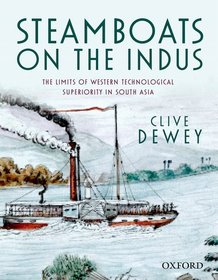
Steamboats on the Indus
The Limits of Western Technological Superiority in South Asia
-
10% KEDVEZMÉNY?
- A kedvezmény csak az 'Értesítés a kedvenc témákról' hírlevelünk címzettjeinek rendeléseire érvényes.
- Kiadói listaár GBP 76.00
-
34 314 Ft (32 680 Ft + 5% áfa)
Az ár azért becsült, mert a rendelés pillanatában nem lehet pontosan tudni, hogy a beérkezéskor milyen lesz a forint árfolyama az adott termék eredeti devizájához képest. Ha a forint romlana, kissé többet, ha javulna, kissé kevesebbet kell majd fizetnie.
- Kedvezmény(ek) 10% (kb. 3 431 Ft)
- Kedvezményes ár 30 883 Ft (29 412 Ft + 5% áfa)
Iratkozzon fel most és részesüljön kedvezőbb árainkból!
Feliratkozom
34 314 Ft

Beszerezhetőség
Csak rendelésre kapható a kiadónál, kissé időigényes.
Why don't you give exact delivery time?
A beszerzés időigényét az eddigi tapasztalatokra alapozva adjuk meg. Azért becsült, mert a terméket külföldről hozzuk be, így a kiadó kiszolgálásának pillanatnyi gyorsaságától is függ. A megadottnál gyorsabb és lassabb szállítás is elképzelhető, de mindent megteszünk, hogy Ön a lehető leghamarabb jusson hozzá a termékhez.
A termék adatai:
- Kiadó OUP India
- Megjelenés dátuma 2014. október 2.
- ISBN 9780198092193
- Kötéstípus Keménykötés
- Terjedelem360 oldal
- Méret 288x224x28 mm
- Súly 1342 g
- Nyelv angol
- Illusztrációk 14 colour & 45 b/w 0
Kategóriák
Rövid leírás:
Two forms of water-transport competed for supremacy on the Indus and its tributaries in the middle of the nineteenth century: the local country boats and the steamboats imported by the British. Though the steamers were the most advanced technology in South Asia, yet the country boats kept the river trade while the steam flotillas went bankrupt. Steamboats on the Indus shows that the received wisdom-the 'Technology and Imperialism' school-is wrong to assume that Westerm machines destroyed indigenous techniques wherever they came into competition.
TöbbHosszú leírás:
Two forms of water-transport competed for supremacy on the Indus and its tributaries in the middle of the nineteenth century: the local country boats and the steamboats imported by the British.
The steamers were the most advanced technology in South Asia. British investors poured capital into them, colonial officials subsidised them, and European travellers patronized them. The country boats-blown by the winds, rowed by the oars, dragged by ropes-had hardly changed in a thousand years. Yet the country boats kept the river trade while the steam flotillas went bankrupt. They were far better adapted to the shallow, shifting rivers; they were much cheaper to build and operate; and they drew on an extraordinary pool of skills-the skills of boatsmen and boat-builders.
Steamboats on the Indus shows that the received wisdom-the 'Technology and Imperialism' school-is wrong to assume that Western machines destroyed indigenous techniques wherever they came into competition. Traditional technology could exploit the economic opportunities created by imperialism at lower cost than the most advanced machinery from the West.
Dewey's meticulously researched account of the Indus steamboats is entertaining, ironic and scholarly. he demonstrates convincingly that, while steam technology had an almost magical hold over the Victorian imagination, in the Indus that technology met its match.
Tartalomjegyzék:
List of Illustrations
List of Maps, Figures, and Tables
Preface
A Note on Conventions
1. Introduction
Part I: Constraints
2. The Rivers: The 'Hazards of Navigation'
3. The Steamboats: The Technological Trap
4. The Money: Costs and Losses
Part II: Activities
5. Passengers
6. Cargoes
7. The Steamboats' Military Role
Part III: Competitors
8. The Indian Summer of the Country Boats
9. The Country Boats and the Country Boatmen
10. The Fate of the Ferries
Part IV: Rationale
11. The Psychological Impact of the Steamboats
12. The Sting in the Tale
Appendix: The Statistics on the Country Boats
Glossary
Select Bibliography
Index
About the Author

