

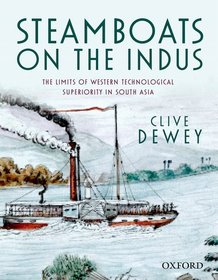
Steamboats on the Indus
The Limits of Western Technological Superiority in South Asia
- Publisher's listprice GBP 76.00
-
34 314 Ft (32 680 Ft + 5% VAT)
The price is estimated because at the time of ordering we do not know what conversion rates will apply to HUF / product currency when the book arrives. In case HUF is weaker, the price increases slightly, in case HUF is stronger, the price goes lower slightly.
- Discount 10% (cc. 3 431 Ft off)
- Discounted price 30 883 Ft (29 412 Ft + 5% VAT)
Subcribe now and take benefit of a favourable price.
Subscribe
34 314 Ft

Availability
Only to order.
Why don't you give exact delivery time?
Delivery time is estimated on our previous experiences. We give estimations only, because we order from outside Hungary, and the delivery time mainly depends on how quickly the publisher supplies the book. Faster or slower deliveries both happen, but we do our best to supply as quickly as possible.
Product details:
- Publisher OUP India
- Date of Publication 2 October 2014
- ISBN 9780198092193
- Binding Hardback
- No. of pages360 pages
- Size 288x224x28 mm
- Weight 1342 g
- Language English
- Illustrations 14 colour & 45 b/w 0
Categories
Short description:
Two forms of water-transport competed for supremacy on the Indus and its tributaries in the middle of the nineteenth century: the local country boats and the steamboats imported by the British. Though the steamers were the most advanced technology in South Asia, yet the country boats kept the river trade while the steam flotillas went bankrupt. Steamboats on the Indus shows that the received wisdom-the 'Technology and Imperialism' school-is wrong to assume that Westerm machines destroyed indigenous techniques wherever they came into competition.
MoreLong description:
Two forms of water-transport competed for supremacy on the Indus and its tributaries in the middle of the nineteenth century: the local country boats and the steamboats imported by the British.
The steamers were the most advanced technology in South Asia. British investors poured capital into them, colonial officials subsidised them, and European travellers patronized them. The country boats-blown by the winds, rowed by the oars, dragged by ropes-had hardly changed in a thousand years. Yet the country boats kept the river trade while the steam flotillas went bankrupt. They were far better adapted to the shallow, shifting rivers; they were much cheaper to build and operate; and they drew on an extraordinary pool of skills-the skills of boatsmen and boat-builders.
Steamboats on the Indus shows that the received wisdom-the 'Technology and Imperialism' school-is wrong to assume that Western machines destroyed indigenous techniques wherever they came into competition. Traditional technology could exploit the economic opportunities created by imperialism at lower cost than the most advanced machinery from the West.
Dewey's meticulously researched account of the Indus steamboats is entertaining, ironic and scholarly. he demonstrates convincingly that, while steam technology had an almost magical hold over the Victorian imagination, in the Indus that technology met its match.
Table of Contents:
List of Illustrations
List of Maps, Figures, and Tables
Preface
A Note on Conventions
1. Introduction
Part I: Constraints
2. The Rivers: The 'Hazards of Navigation'
3. The Steamboats: The Technological Trap
4. The Money: Costs and Losses
Part II: Activities
5. Passengers
6. Cargoes
7. The Steamboats' Military Role
Part III: Competitors
8. The Indian Summer of the Country Boats
9. The Country Boats and the Country Boatmen
10. The Fate of the Ferries
Part IV: Rationale
11. The Psychological Impact of the Steamboats
12. The Sting in the Tale
Appendix: The Statistics on the Country Boats
Glossary
Select Bibliography
Index
About the Author

