

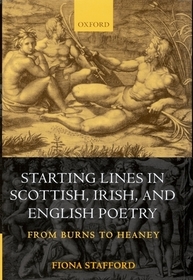
Starting Lines in Scottish, Irish, and English Poetry
From Burns to Heaney
-
10% KEDVEZMÉNY?
- A kedvezmény csak az 'Értesítés a kedvenc témákról' hírlevelünk címzettjeinek rendeléseire érvényes.
- Kiadói listaár GBP 79.00
-
35 668 Ft (33 970 Ft + 5% áfa)
Az ár azért becsült, mert a rendelés pillanatában nem lehet pontosan tudni, hogy a beérkezéskor milyen lesz a forint árfolyama az adott termék eredeti devizájához képest. Ha a forint romlana, kissé többet, ha javulna, kissé kevesebbet kell majd fizetnie.
- Kedvezmény(ek) 10% (kb. 3 566 Ft)
- Kedvezményes ár 32 102 Ft (30 573 Ft + 5% áfa)
Iratkozzon fel most és részesüljön kedvezőbb árainkból!
Feliratkozom
35 668 Ft

Beszerezhetőség
Megrendelésre a kiadó utánnyomja a könyvet. Rendelhető, de a szokásosnál kicsit lassabban érkezik meg.
Why don't you give exact delivery time?
A beszerzés időigényét az eddigi tapasztalatokra alapozva adjuk meg. Azért becsült, mert a terméket külföldről hozzuk be, így a kiadó kiszolgálásának pillanatnyi gyorsaságától is függ. A megadottnál gyorsabb és lassabb szállítás is elképzelhető, de mindent megteszünk, hogy Ön a lehető leghamarabb jusson hozzá a termékhez.
A termék adatai:
- Kiadó OUP Oxford
- Megjelenés dátuma 2000. november 30.
- ISBN 9780198186373
- Kötéstípus Keménykötés
- Terjedelem368 oldal
- Méret 225x146x23 mm
- Súly 549 g
- Nyelv angol 0
Kategóriák
Rövid leírás:
In a series of illuminating close readings, Fiona Stafford explores the use of earlier poems as starting points for new work. Each chapter discusses a Scottish, English, or Irish poem that begins with a line from one of the other national literatures of the British Isles, considering whether issues of originality, influence, and inheritance are essentially political as well as literary.
TöbbHosszú leírás:
Why should a poem begin with a line from another poem? Is an eighteenth-century epigraph working in the same way as a post-modern quotation? And how are the dynamics of the new text and the source affected by issues of nationhood, language, history, and cultural tradition? Are literary ideas of originality and imitation, allusion and influence inherently political if the poems emerge from different sides of a border or of a colonial relationship?
Taking as a framework the history of relations between Ireland, England, and Scotland since the 1707 Union, the book explores such questions through a series of close readings. Textual encounters singled out for detailed discussion include Burns's use of Shakespeare, Coleridge's reference to 'Sir Patrick Spens', James Clarence Mangan's adaptation of Percy Bysshe Shelley, Ciaran Carson's quotation from John Keats, Seamus Heaney's meditation on Henry Vaughan, and the evolution of 'The Homes of England' from Felicia Hemans to Noel Coward.
This is a work of mature scholarship; its references inform, delight and open new avenues of connectedness at every turn. It is also unpretentiously, generously written: the speaking voice and personal enthusiasms of the best kind of teacher hold interest across an impressively broad span of poetic analysis ... It is as persuasive an advocacy of the pleasure of poetry as I have read in years.
Tartalomjegyzék:
'What's Past is Prologue'
ScottishBards and English Epigraphs: Robert Burns's 'A Winter Night'
The Grand Old Ballad in Coleridge's 'Dejection'
James Clarence Mangan and Percy Bysshe Shelley
The Homes of England
'The Irish for No'
Seamus Heaney and the Caught Line
Epilogue: George Mackay Brown, 'All Soul's'
Conclusion: George Mackay Brown, 'All Soul's' (text of poem)
Bibliography
Index

