

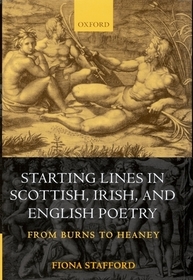
Starting Lines in Scottish, Irish, and English Poetry
From Burns to Heaney
- Publisher's listprice GBP 79.00
-
35 668 Ft (33 970 Ft + 5% VAT)
The price is estimated because at the time of ordering we do not know what conversion rates will apply to HUF / product currency when the book arrives. In case HUF is weaker, the price increases slightly, in case HUF is stronger, the price goes lower slightly.
- Discount 10% (cc. 3 566 Ft off)
- Discounted price 32 102 Ft (30 573 Ft + 5% VAT)
Subcribe now and take benefit of a favourable price.
Subscribe
35 668 Ft

Availability
printed on demand
Why don't you give exact delivery time?
Delivery time is estimated on our previous experiences. We give estimations only, because we order from outside Hungary, and the delivery time mainly depends on how quickly the publisher supplies the book. Faster or slower deliveries both happen, but we do our best to supply as quickly as possible.
Product details:
- Publisher OUP Oxford
- Date of Publication 30 November 2000
- ISBN 9780198186373
- Binding Hardback
- No. of pages368 pages
- Size 225x146x23 mm
- Weight 549 g
- Language English 0
Categories
Short description:
In a series of illuminating close readings, Fiona Stafford explores the use of earlier poems as starting points for new work. Each chapter discusses a Scottish, English, or Irish poem that begins with a line from one of the other national literatures of the British Isles, considering whether issues of originality, influence, and inheritance are essentially political as well as literary.
MoreLong description:
Why should a poem begin with a line from another poem? Is an eighteenth-century epigraph working in the same way as a post-modern quotation? And how are the dynamics of the new text and the source affected by issues of nationhood, language, history, and cultural tradition? Are literary ideas of originality and imitation, allusion and influence inherently political if the poems emerge from different sides of a border or of a colonial relationship?
Taking as a framework the history of relations between Ireland, England, and Scotland since the 1707 Union, the book explores such questions through a series of close readings. Textual encounters singled out for detailed discussion include Burns's use of Shakespeare, Coleridge's reference to 'Sir Patrick Spens', James Clarence Mangan's adaptation of Percy Bysshe Shelley, Ciaran Carson's quotation from John Keats, Seamus Heaney's meditation on Henry Vaughan, and the evolution of 'The Homes of England' from Felicia Hemans to Noel Coward.
This is a work of mature scholarship; its references inform, delight and open new avenues of connectedness at every turn. It is also unpretentiously, generously written: the speaking voice and personal enthusiasms of the best kind of teacher hold interest across an impressively broad span of poetic analysis ... It is as persuasive an advocacy of the pleasure of poetry as I have read in years.
Table of Contents:
'What's Past is Prologue'
ScottishBards and English Epigraphs: Robert Burns's 'A Winter Night'
The Grand Old Ballad in Coleridge's 'Dejection'
James Clarence Mangan and Percy Bysshe Shelley
The Homes of England
'The Irish for No'
Seamus Heaney and the Caught Line
Epilogue: George Mackay Brown, 'All Soul's'
Conclusion: George Mackay Brown, 'All Soul's' (text of poem)
Bibliography
Index

