

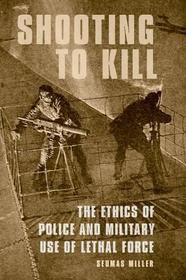
Shooting to Kill
The Ethics of Police and Military Use of Lethal Force
-
10% KEDVEZMÉNY?
- A kedvezmény csak az 'Értesítés a kedvenc témákról' hírlevelünk címzettjeinek rendeléseire érvényes.
- Kiadói listaár GBP 41.49
-
19 821 Ft (18 877 Ft + 5% áfa)
Az ár azért becsült, mert a rendelés pillanatában nem lehet pontosan tudni, hogy a beérkezéskor milyen lesz a forint árfolyama az adott termék eredeti devizájához képest. Ha a forint romlana, kissé többet, ha javulna, kissé kevesebbet kell majd fizetnie.
- Kedvezmény(ek) 10% (cc. 1 982 Ft off)
- Kedvezményes ár 17 839 Ft (16 989 Ft + 5% áfa)
Iratkozzon fel most és részesüljön kedvezőbb árainkból!
Feliratkozom
19 821 Ft

Beszerezhetőség
Megrendelésre a kiadó utánnyomja a könyvet. Rendelhető, de a szokásosnál kicsit lassabban érkezik meg.
Why don't you give exact delivery time?
A beszerzés időigényét az eddigi tapasztalatokra alapozva adjuk meg. Azért becsült, mert a terméket külföldről hozzuk be, így a kiadó kiszolgálásának pillanatnyi gyorsaságától is függ. A megadottnál gyorsabb és lassabb szállítás is elképzelhető, de mindent megteszünk, hogy Ön a lehető leghamarabb jusson hozzá a termékhez.
A termék adatai:
- Kiadó OUP USA
- Megjelenés dátuma 2016. december 8.
- ISBN 9780190626143
- Kötéstípus Puhakötés
- Terjedelem308 oldal
- Méret 152x231x17 mm
- Súly 454 g
- Nyelv angol 0
Kategóriák
Rövid leírás:
In this book, philosopher Seumas Miller analyzes the various moral justifications and moral responsibilities involved in the use of lethal force by police and military, relying on a distinctive normative teleological account of institutional roles.
TöbbHosszú leírás:
Terrorism, the use of military force in Afghanistan, Iraq and Syria, and the fatal police shootings of unarmed persons have all contributed to renewed interest in the ethics of police and military use of lethal force and its moral justification.
In this book, philosopher Seumas Miller analyzes the various moral justifications and moral responsibilities involved in the use of lethal force by police and military combatants, relying on a distinctive normative teleological account of institutional roles. His conception constitutes a novel alternative to prevailing reductive individualist and collectivist accounts. As Miller argues, police and military uses of lethal force are morally justified in part by recourse to fundamental natural moral rights and obligations, especially the right to personal self-defense and the moral obligation to defend the lives of innocent others. Yet the moral justification for police and military use of lethal force is to some extent role-specific. Both police officers and military combatants evidently have an institutionally-based moral duty to put themselves in harm's way to protect others. Under some circumstances, however, police have an institutionally based moral duty to use lethal force to uphold the law; and military combatants have an institutionally based moral duty to use lethal force to win wars. Two key notions in play are joint action and the natural right to self-defense. Miller uses a relational individualist theory of joint actions to construct the notion of multi-layered structures of joint action in order to explicate organizational action. He also provides a novel theory of justifiable killing in self-defense. Over the course of his book, Miller covers a variety of urgent topics, such as police shootings of armed offenders, police shooting of suicide-bombers, targeted killing, autonomous weapons, humanitarian armed intervention, and civilian immunity.
Miller is engaging the revisionists [theories of the use of lethal force] and putting forth a substantial alternative [theory] at a high levelhis institutional approach speaks to those people and their experiences who are (or may be) engaged in using lethal force in law enforcement and war.I also find Miller's "collective end theory" (CET) of joint action to be excellent He has an excellent approach to joint action that accounts for individual moral responsibility.
Tartalomjegyzék:
Introduction
Chapter 1 Morally Permissible Use of Lethal Force: A Taxonomy
Chapter 2 Killing in Self-Defence
Chapter 3 Police Officers, Regular Soldiers and Normative Institutional Analysis
Chapter 4 Police Use of Lethal Force
Chapter 5 Police Use of Lethal Force and Suicide Bombers
Chapter 6 Military Use of Lethal Force
Chapter 7 Civilian Immunity
Chapter 8 Humanitarian Armed Intervention
Chapter 9 Targeted Killing
Chapter 10 Autonomous Weapons and Moral Responsibility
Conclusion

