

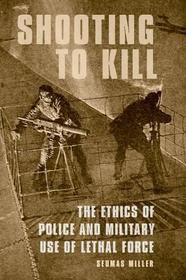
Shooting to Kill
The Ethics of Police and Military Use of Lethal Force
- Publisher's listprice GBP 41.49
-
19 821 Ft (18 877 Ft + 5% VAT)
The price is estimated because at the time of ordering we do not know what conversion rates will apply to HUF / product currency when the book arrives. In case HUF is weaker, the price increases slightly, in case HUF is stronger, the price goes lower slightly.
- Discount 10% (cc. 1 982 Ft off)
- Discounted price 17 839 Ft (16 989 Ft + 5% VAT)
Subcribe now and take benefit of a favourable price.
Subscribe
19 821 Ft

Availability
printed on demand
Why don't you give exact delivery time?
Delivery time is estimated on our previous experiences. We give estimations only, because we order from outside Hungary, and the delivery time mainly depends on how quickly the publisher supplies the book. Faster or slower deliveries both happen, but we do our best to supply as quickly as possible.
Product details:
- Publisher OUP USA
- Date of Publication 8 December 2016
- ISBN 9780190626143
- Binding Paperback
- No. of pages308 pages
- Size 152x231x17 mm
- Weight 454 g
- Language English 0
Categories
Short description:
In this book, philosopher Seumas Miller analyzes the various moral justifications and moral responsibilities involved in the use of lethal force by police and military, relying on a distinctive normative teleological account of institutional roles.
MoreLong description:
Terrorism, the use of military force in Afghanistan, Iraq and Syria, and the fatal police shootings of unarmed persons have all contributed to renewed interest in the ethics of police and military use of lethal force and its moral justification.
In this book, philosopher Seumas Miller analyzes the various moral justifications and moral responsibilities involved in the use of lethal force by police and military combatants, relying on a distinctive normative teleological account of institutional roles. His conception constitutes a novel alternative to prevailing reductive individualist and collectivist accounts. As Miller argues, police and military uses of lethal force are morally justified in part by recourse to fundamental natural moral rights and obligations, especially the right to personal self-defense and the moral obligation to defend the lives of innocent others. Yet the moral justification for police and military use of lethal force is to some extent role-specific. Both police officers and military combatants evidently have an institutionally-based moral duty to put themselves in harm's way to protect others. Under some circumstances, however, police have an institutionally based moral duty to use lethal force to uphold the law; and military combatants have an institutionally based moral duty to use lethal force to win wars. Two key notions in play are joint action and the natural right to self-defense. Miller uses a relational individualist theory of joint actions to construct the notion of multi-layered structures of joint action in order to explicate organizational action. He also provides a novel theory of justifiable killing in self-defense. Over the course of his book, Miller covers a variety of urgent topics, such as police shootings of armed offenders, police shooting of suicide-bombers, targeted killing, autonomous weapons, humanitarian armed intervention, and civilian immunity.
Miller is engaging the revisionists [theories of the use of lethal force] and putting forth a substantial alternative [theory] at a high levelhis institutional approach speaks to those people and their experiences who are (or may be) engaged in using lethal force in law enforcement and war.I also find Miller's "collective end theory" (CET) of joint action to be excellent He has an excellent approach to joint action that accounts for individual moral responsibility.
Table of Contents:
Introduction
Chapter 1 Morally Permissible Use of Lethal Force: A Taxonomy
Chapter 2 Killing in Self-Defence
Chapter 3 Police Officers, Regular Soldiers and Normative Institutional Analysis
Chapter 4 Police Use of Lethal Force
Chapter 5 Police Use of Lethal Force and Suicide Bombers
Chapter 6 Military Use of Lethal Force
Chapter 7 Civilian Immunity
Chapter 8 Humanitarian Armed Intervention
Chapter 9 Targeted Killing
Chapter 10 Autonomous Weapons and Moral Responsibility
Conclusion

