

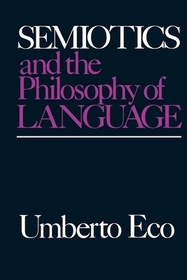
Semiotics and the Philosophy of Language
Sorozatcím: Advances in Semiotics;
-
10% KEDVEZMÉNY?
- A kedvezmény csak az 'Értesítés a kedvenc témákról' hírlevelünk címzettjeinek rendeléseire érvényes.
- Kiadói listaár GBP 17.99
-
8 122 Ft (7 735 Ft + 5% áfa)
Az ár azért becsült, mert a rendelés pillanatában nem lehet pontosan tudni, hogy a beérkezéskor milyen lesz a forint árfolyama az adott termék eredeti devizájához képest. Ha a forint romlana, kissé többet, ha javulna, kissé kevesebbet kell majd fizetnie.
- Kedvezmény(ek) % (cc. 0 Ft off)
- Kedvezményes ár 0 Ft (0 Ft + 5% áfa)
Iratkozzon fel most és részesüljön kedvezőbb árainkból!
Feliratkozom
8 122 Ft

Beszerezhetőség
A kiadónál véglegesen elfogyott, nem rendelhető. Érdemes újra keresni a címmel, hátha van újabb kiadás.
Why don't you give exact delivery time?
A beszerzés időigényét az eddigi tapasztalatokra alapozva adjuk meg. Azért becsült, mert a terméket külföldről hozzuk be, így a kiadó kiszolgálásának pillanatnyi gyorsaságától is függ. A megadottnál gyorsabb és lassabb szállítás is elképzelhető, de mindent megteszünk, hogy Ön a lehető leghamarabb jusson hozzá a termékhez.
A termék adatai:
- Kiadó Indiana University Press
- Megjelenés dátuma 1986. július 22.
- Kötetek száma Print PDF
- ISBN 9780253203984
- Kötéstípus Puhakötés
- Terjedelem256 oldal
- Méret 235x156 mm
- Súly 363 g
- Nyelv angol 0
Kategóriák
Hosszú leírás:
"
""Eco wittily and enchantingly develops themes often touched on in his previous works, but he delves deeper into their complex nature . . . this collection can be read with pleasure by those unversed in semiotic theory."" —Times Literary Supplement
" TöbbTartalomjegyzék:
Introduction
1. Signs
1.1. Crisis of a concept
1.2. The signs of an obstinacy
1.3. Intension and extension
1.4. Elusive solutions
1.5. The deconstruction of the linguistic sign
1.6. Signs vs. words
1.7. The stoics
1.8. Unification of the theories and the predominance of linguistics
1.9. The 'instructional' model
1.10. Strong codes and weak codes
1.11. Abduction and inferential nature of signs
1.12. The criterion of interpretability
1.13. Sign and subject
2. Dictionary vs. Encyclopedia
2.1. Porphyry strikes back
2.2 Critique of the Porphyrian tree
2.3. Encyclopedias
3. Metaphor
3.1. The metaphoric nexus
3.2. Traditional definitions
3.3. Aristotle: synecdoche and Porphyrian tree
3.4. Aristotle: metaphors of three terms
3.5. Aristotle: the proportional scheme
3.6. Proportion and condensation
3.7. Dictionary and encyclopedia
3.8. The cognitive function
3.9. The semiosic background: the system of content
3.10. The limits of formalization
3.11. Componential representation and the pragmatics of the text
3.12. Conclusions
4. Symbol
4.1. Genus and species
4.2. Expressions by ratio facilis
4.3. Expressions produced by ratio difficilis
4.4. The symbolic mode
4.5. Semiotics of the symbolic mode
4.6. Conclusions
5. Code
5.1. The rise of new category
5.2. The landslide effect
5.3. Codes and communication
5.4. Codes as s-codes
5.5. Cryptography and natural languages
5.6. S-codes and signification
5.7 The genetic code
5.8. Toward a provisonal conclusion
6. Isotopy
6.1. Discursive isotopies within sentences with paradigmatic disjunction
6.2. Discursive isotopies within sentences with syntagmatic disjunction
6.3. Discursive isotopies between sentences with paradigmatic disjunction
6.4. Discursive isotopies between sentences with syntagmatic disjunction
6.5. Narrative isotopies connected with isotopic discursive disjunctions generating mutually exlusive stories
6.6 Narrative isotopies connected with isotopic discursive disjunctions that generate complementary stories
6.7. Narrative isotopies connected with discursive isotopic disjunctions that generate complementary stoies in each case
6.8. Extensional isotopies
6.9. Provisional conclusions
7. Mirrors
7.1. Is the mirror image a sign?
7.2. The imaginary and the symbolic
7.3. Getting in through the Mirror
7.4. A phenomenology of the mirror: the mirror does not invert
7.5. A pragmatics of the mirror
7.6. The mirror as a prosthesis and a channel
7.7. Absolute icons
7.8. Mirrors as rigid designators
7.9. On signs
7.10. Why mirrors do not produce signs
7.11. Freaks: distorting mirrors
7.12. Procatoptric staging
7.13. Rainbows and Fata Morganas
7.14. Catoptric theaters
7.15. Mirrors that 'freeze' images
7.16. The experimentum crucis
References
Index of authors
Index of subjects

