

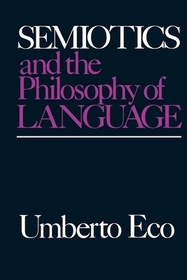
Semiotics and the Philosophy of Language
Series: Advances in Semiotics;
- Publisher's listprice GBP 17.99
-
8 122 Ft (7 735 Ft + 5% VAT)
The price is estimated because at the time of ordering we do not know what conversion rates will apply to HUF / product currency when the book arrives. In case HUF is weaker, the price increases slightly, in case HUF is stronger, the price goes lower slightly.
- Discount % (cc. 0 Ft off)
- Discounted price 0 Ft (0 Ft + 5% VAT)
Subcribe now and take benefit of a favourable price.
Subscribe
8 122 Ft

Availability
Out of print
Why don't you give exact delivery time?
Delivery time is estimated on our previous experiences. We give estimations only, because we order from outside Hungary, and the delivery time mainly depends on how quickly the publisher supplies the book. Faster or slower deliveries both happen, but we do our best to supply as quickly as possible.
Product details:
- Publisher Indiana University Press
- Date of Publication 22 July 1986
- Number of Volumes Print PDF
- ISBN 9780253203984
- Binding Paperback
- No. of pages256 pages
- Size 235x156 mm
- Weight 363 g
- Language English 0
Categories
Long description:
"
""Eco wittily and enchantingly develops themes often touched on in his previous works, but he delves deeper into their complex nature . . . this collection can be read with pleasure by those unversed in semiotic theory."" —Times Literary Supplement
" MoreTable of Contents:
Introduction
1. Signs
1.1. Crisis of a concept
1.2. The signs of an obstinacy
1.3. Intension and extension
1.4. Elusive solutions
1.5. The deconstruction of the linguistic sign
1.6. Signs vs. words
1.7. The stoics
1.8. Unification of the theories and the predominance of linguistics
1.9. The 'instructional' model
1.10. Strong codes and weak codes
1.11. Abduction and inferential nature of signs
1.12. The criterion of interpretability
1.13. Sign and subject
2. Dictionary vs. Encyclopedia
2.1. Porphyry strikes back
2.2 Critique of the Porphyrian tree
2.3. Encyclopedias
3. Metaphor
3.1. The metaphoric nexus
3.2. Traditional definitions
3.3. Aristotle: synecdoche and Porphyrian tree
3.4. Aristotle: metaphors of three terms
3.5. Aristotle: the proportional scheme
3.6. Proportion and condensation
3.7. Dictionary and encyclopedia
3.8. The cognitive function
3.9. The semiosic background: the system of content
3.10. The limits of formalization
3.11. Componential representation and the pragmatics of the text
3.12. Conclusions
4. Symbol
4.1. Genus and species
4.2. Expressions by ratio facilis
4.3. Expressions produced by ratio difficilis
4.4. The symbolic mode
4.5. Semiotics of the symbolic mode
4.6. Conclusions
5. Code
5.1. The rise of new category
5.2. The landslide effect
5.3. Codes and communication
5.4. Codes as s-codes
5.5. Cryptography and natural languages
5.6. S-codes and signification
5.7 The genetic code
5.8. Toward a provisonal conclusion
6. Isotopy
6.1. Discursive isotopies within sentences with paradigmatic disjunction
6.2. Discursive isotopies within sentences with syntagmatic disjunction
6.3. Discursive isotopies between sentences with paradigmatic disjunction
6.4. Discursive isotopies between sentences with syntagmatic disjunction
6.5. Narrative isotopies connected with isotopic discursive disjunctions generating mutually exlusive stories
6.6 Narrative isotopies connected with isotopic discursive disjunctions that generate complementary stories
6.7. Narrative isotopies connected with discursive isotopic disjunctions that generate complementary stoies in each case
6.8. Extensional isotopies
6.9. Provisional conclusions
7. Mirrors
7.1. Is the mirror image a sign?
7.2. The imaginary and the symbolic
7.3. Getting in through the Mirror
7.4. A phenomenology of the mirror: the mirror does not invert
7.5. A pragmatics of the mirror
7.6. The mirror as a prosthesis and a channel
7.7. Absolute icons
7.8. Mirrors as rigid designators
7.9. On signs
7.10. Why mirrors do not produce signs
7.11. Freaks: distorting mirrors
7.12. Procatoptric staging
7.13. Rainbows and Fata Morganas
7.14. Catoptric theaters
7.15. Mirrors that 'freeze' images
7.16. The experimentum crucis
References
Index of authors
Index of subjects

