

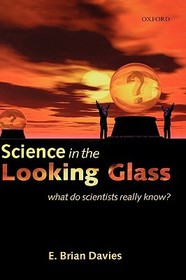
Science in the Looking Glass
What do scientists really know?
-
10% KEDVEZMÉNY?
- A kedvezmény csak az 'Értesítés a kedvenc témákról' hírlevelünk címzettjeinek rendeléseire érvényes.
- Kiadói listaár GBP 36.99
-
16 700 Ft (15 905 Ft + 5% áfa)
Az ár azért becsült, mert a rendelés pillanatában nem lehet pontosan tudni, hogy a beérkezéskor milyen lesz a forint árfolyama az adott termék eredeti devizájához képest. Ha a forint romlana, kissé többet, ha javulna, kissé kevesebbet kell majd fizetnie.
- Kedvezmény(ek) 10% (kb. 1 670 Ft)
- Kedvezményes ár 15 030 Ft (14 315 Ft + 5% áfa)
Iratkozzon fel most és részesüljön kedvezőbb árainkból!
Feliratkozom
16 700 Ft

Beszerezhetőség
Megrendelésre a kiadó utánnyomja a könyvet. Rendelhető, de a szokásosnál kicsit lassabban érkezik meg.
Why don't you give exact delivery time?
A beszerzés időigényét az eddigi tapasztalatokra alapozva adjuk meg. Azért becsült, mert a terméket külföldről hozzuk be, így a kiadó kiszolgálásának pillanatnyi gyorsaságától is függ. A megadottnál gyorsabb és lassabb szállítás is elképzelhető, de mindent megteszünk, hogy Ön a lehető leghamarabb jusson hozzá a termékhez.
A termék adatai:
- Kiadó OUP Oxford
- Megjelenés dátuma 2003. augusztus 7.
- ISBN 9780198525431
- Kötéstípus Keménykötés
- Terjedelem308 oldal
- Méret 242x161x21 mm
- Súly 684 g
- Nyelv angol
- Illusztrációk 29 b/w line figs; 8 b/w halftone figs 0
Kategóriák
Rövid leírás:
How do scientific conjectures become laws? Why does proof mean different things in different sciences? Do numbers exist, or were they invented? Why do some laws turn out to be wrong? Experience shows that disentangling scientific knowledge from opinion is harder than one might expect. Full of illuminating examples and quotations, and with a scope ranging from psychology and evolution to quantum theory and mathematics, this book brings alive issues at the heart of all science.
TöbbHosszú leírás:
In this wide-ranging book, Brian Davies discusses the basis for scientists' claims to knowledge about the world. He looks at science historically, emphasizing not only the achievements of scientists from Galileo onwards, but also their mistakes. He rejects the claim that all scientific knowledge is provisional, by citing examples from chemistry, biology and geology. A major feature of the book is its defence of the view that mathematics was invented rather than discovered. A large number of examples are used to illustrate these points, and many of the deep issues in today's world discussed - from psychology and evolution to quantum theory, consciousness and even religious belief. Disentangling knowledge from opinion and aspiration is a hard task, but this book provides a clear guide to the difficulties.
...it is a brilliant work, beautifully written, and brimming with surprising information and stimulating philosophical speculations. Notices of the AMS, December 2005, Volume 52, Number 11.
Tartalomjegyzék:
Perception and Language
Theories of the Mind
Arithmetic
How Hard can Problems get?
Pure Mathematics
Mechanics and Astronomy
Probability and Quantum Theory
Is Evolution a Theory?
Against Reductionism
Some Final Thoughts

