

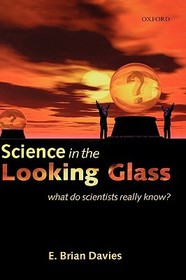
Science in the Looking Glass
What do scientists really know?
- Publisher's listprice GBP 36.99
-
16 700 Ft (15 905 Ft + 5% VAT)
The price is estimated because at the time of ordering we do not know what conversion rates will apply to HUF / product currency when the book arrives. In case HUF is weaker, the price increases slightly, in case HUF is stronger, the price goes lower slightly.
- Discount 10% (cc. 1 670 Ft off)
- Discounted price 15 030 Ft (14 315 Ft + 5% VAT)
Subcribe now and take benefit of a favourable price.
Subscribe
16 700 Ft

Availability
printed on demand
Why don't you give exact delivery time?
Delivery time is estimated on our previous experiences. We give estimations only, because we order from outside Hungary, and the delivery time mainly depends on how quickly the publisher supplies the book. Faster or slower deliveries both happen, but we do our best to supply as quickly as possible.
Product details:
- Publisher OUP Oxford
- Date of Publication 7 August 2003
- ISBN 9780198525431
- Binding Hardback
- No. of pages308 pages
- Size 242x161x21 mm
- Weight 684 g
- Language English
- Illustrations 29 b/w line figs; 8 b/w halftone figs 0
Categories
Short description:
How do scientific conjectures become laws? Why does proof mean different things in different sciences? Do numbers exist, or were they invented? Why do some laws turn out to be wrong? Experience shows that disentangling scientific knowledge from opinion is harder than one might expect. Full of illuminating examples and quotations, and with a scope ranging from psychology and evolution to quantum theory and mathematics, this book brings alive issues at the heart of all science.
MoreLong description:
In this wide-ranging book, Brian Davies discusses the basis for scientists' claims to knowledge about the world. He looks at science historically, emphasizing not only the achievements of scientists from Galileo onwards, but also their mistakes. He rejects the claim that all scientific knowledge is provisional, by citing examples from chemistry, biology and geology. A major feature of the book is its defence of the view that mathematics was invented rather than discovered. A large number of examples are used to illustrate these points, and many of the deep issues in today's world discussed - from psychology and evolution to quantum theory, consciousness and even religious belief. Disentangling knowledge from opinion and aspiration is a hard task, but this book provides a clear guide to the difficulties.
...it is a brilliant work, beautifully written, and brimming with surprising information and stimulating philosophical speculations. Notices of the AMS, December 2005, Volume 52, Number 11.
Table of Contents:
Perception and Language
Theories of the Mind
Arithmetic
How Hard can Problems get?
Pure Mathematics
Mechanics and Astronomy
Probability and Quantum Theory
Is Evolution a Theory?
Against Reductionism
Some Final Thoughts

