

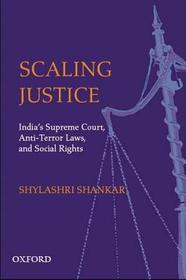
Scaling Justice
India's Supreme Court, Social Rights, and Civil Liberties
-
10% KEDVEZMÉNY?
- A kedvezmény csak az 'Értesítés a kedvenc témákról' hírlevelünk címzettjeinek rendeléseire érvényes.
- Kiadói listaár GBP 18.99
-
8 573 Ft (8 165 Ft + 5% áfa)
Az ár azért becsült, mert a rendelés pillanatában nem lehet pontosan tudni, hogy a beérkezéskor milyen lesz a forint árfolyama az adott termék eredeti devizájához képest. Ha a forint romlana, kissé többet, ha javulna, kissé kevesebbet kell majd fizetnie.
- Kedvezmény(ek) 10% (cc. 857 Ft off)
- Kedvezményes ár 7 716 Ft (7 349 Ft + 5% áfa)
Iratkozzon fel most és részesüljön kedvezőbb árainkból!
Feliratkozom
8 573 Ft

Beszerezhetőség
A kiadónál véglegesen elfogyott, nem rendelhető. Érdemes újra keresni a címmel, hátha van újabb kiadás.
Why don't you give exact delivery time?
A beszerzés időigényét az eddigi tapasztalatokra alapozva adjuk meg. Azért becsült, mert a terméket külföldről hozzuk be, így a kiadó kiszolgálásának pillanatnyi gyorsaságától is függ. A megadottnál gyorsabb és lassabb szállítás is elképzelhető, de mindent megteszünk, hogy Ön a lehető leghamarabb jusson hozzá a termékhez.
A termék adatai:
- Kiadó OUP India
- Megjelenés dátuma 2009. február 12.
- ISBN 9780195693201
- Kötéstípus Keménykötés
- Terjedelem239 oldal
- Méret 258x150x20 mm
- Súly 437 g
- Nyelv angol 0
Kategóriák
Rövid leírás:
This book addresses the question 'What influences the choices and decisions that Indian Supreme Court judges make?' It analyses judges through an approach which sees them as constantly negotiating and interpreting laws within particular political and social contexts.
TöbbHosszú leírás:
This book seeks to answer the question 'What influences the choices and decisions that Indian Supreme Court judges make?'. In different contexts and cases contradictory images remain in circulation; judges are variously described as passive, pro-active, impartial, biased, pro-citizen, pro-business, apolitical, pro-poor etc. After briefly explaining the views in different schools of thought, the author sets out her 'embedded negotiator' approach, which addresses the
diverse influences on judicial decision- makers. In this approach the focus is trained on judges and their constant negotiations within grey zones in the fields of civil liberties and social rights. To establish the validity of the approach the author uses the Probit model, which she also explains
extensively. She studies a sample of civil liberties cases spanning the period 1950 to 2005 and social rights cases post Emergency. She collates the data base of cases with another data base containing characteristics of 116 Supreme Court judges, including religious affiliation. This is the first time that such a model has been used in Indian legal research.
Tartalomjegyzék:
Introduction
Competing Explanations for Judicial Decisions
Profile of an Indian Supreme Court Judge
The Legal Framework of Preventive Detention
Judges and Anti-Terror Laws
Scope for Activism in Social Rights
Judges and Social Rights.

