

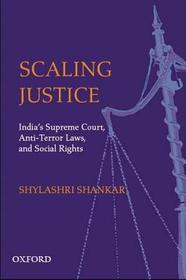
Scaling Justice
India's Supreme Court, Social Rights, and Civil Liberties
- Publisher's listprice GBP 18.99
-
8 573 Ft (8 165 Ft + 5% VAT)
The price is estimated because at the time of ordering we do not know what conversion rates will apply to HUF / product currency when the book arrives. In case HUF is weaker, the price increases slightly, in case HUF is stronger, the price goes lower slightly.
- Discount 10% (cc. 857 Ft off)
- Discounted price 7 716 Ft (7 349 Ft + 5% VAT)
Subcribe now and take benefit of a favourable price.
Subscribe
8 573 Ft

Availability
Out of print
Why don't you give exact delivery time?
Delivery time is estimated on our previous experiences. We give estimations only, because we order from outside Hungary, and the delivery time mainly depends on how quickly the publisher supplies the book. Faster or slower deliveries both happen, but we do our best to supply as quickly as possible.
Product details:
- Publisher OUP India
- Date of Publication 12 February 2009
- ISBN 9780195693201
- Binding Hardback
- No. of pages239 pages
- Size 258x150x20 mm
- Weight 437 g
- Language English 0
Categories
Short description:
This book addresses the question 'What influences the choices and decisions that Indian Supreme Court judges make?' It analyses judges through an approach which sees them as constantly negotiating and interpreting laws within particular political and social contexts.
MoreLong description:
This book seeks to answer the question 'What influences the choices and decisions that Indian Supreme Court judges make?'. In different contexts and cases contradictory images remain in circulation; judges are variously described as passive, pro-active, impartial, biased, pro-citizen, pro-business, apolitical, pro-poor etc. After briefly explaining the views in different schools of thought, the author sets out her 'embedded negotiator' approach, which addresses the
diverse influences on judicial decision- makers. In this approach the focus is trained on judges and their constant negotiations within grey zones in the fields of civil liberties and social rights. To establish the validity of the approach the author uses the Probit model, which she also explains
extensively. She studies a sample of civil liberties cases spanning the period 1950 to 2005 and social rights cases post Emergency. She collates the data base of cases with another data base containing characteristics of 116 Supreme Court judges, including religious affiliation. This is the first time that such a model has been used in Indian legal research.
Table of Contents:
Introduction
Competing Explanations for Judicial Decisions
Profile of an Indian Supreme Court Judge
The Legal Framework of Preventive Detention
Judges and Anti-Terror Laws
Scope for Activism in Social Rights
Judges and Social Rights.

